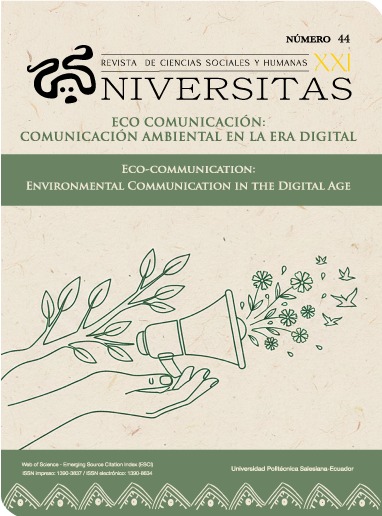
No. 45 (March 2026 – August 2026). From Social Datafication to Hate Speech. Perspectives from Sociology and Communication
2025-08-31
Guest Editors
Dr. Daniel Barredo Ibáñez, Universidad de Sevilla, Spain
Dra. Guadalupe Gómez Abeledo, Universidad Técnica "Luis Vargas Torres" de Esmeraldas, Ecuador
Dr. Juan Carlos Fernández Serrato, Universidad de Sevilla, Spain
Dr. José Luis Anta Félez, Universidad de Jaén, Spain
Deadline for article submission: July 30th, 2026
Abstract
As these lines are being read, approximately six out of ten people worldwide are experiencing economic hardship (UN, 2025), while the United Nations itself warns of the progressive erosion of the so-called “social contract” (p. 28). This process is reflected in rising insecurity, deregulation, and the withdrawal of the State precisely from those areas where its redistributive role is most urgently needed, such as education and healthcare. Underlying the increase in precarity and poverty is the consolidation of an exacerbated individualism, closely linked to the structural logics of contemporary capitalism.
At the same time, climate change is reshaping entire countries and regions (Ripple et al., 2025), demonstrating that nature not only reorganizes ecosystems but also produces profound and sustained deteriorations in human quality of life on a global scale. In this context, the 2030 Agenda and the 17 Sustainable Development Goals (Salvia et al., 2019), launched in 2016 as a proposal for economic, social, and environmental transformation articulated through global dialogue, have been significantly disrupted due to the crisis of multilateralism (D’Angelo, 2025) and the weakening of international cooperation. Rather than representing a closed horizon of solutions, this agenda exposes the structural tensions and limitations of current institutional frameworks in addressing contemporary ecosocial challenges.
Against the backdrop of the crisis of the Welfare State and the emergence of political leaderships that replace social agendas with forms of populism grounded in infotainment, hate speech, and the reactivation of nationalist imaginaries (Castagno, 2025), we are witnessing a profound reconfiguration of the public sphere. These leaderships rely on intense emotional appeals and the evocation of idealized pasts in the absence of collective projects for the future. Their consolidation is decisively supported by an increasingly personalized media ecosystem—digital platforms and social networks—that does not filter, contrast, or verify content, but instead amplifies polarizing discourses tailored to individual biases through algorithmic microtargeting strategies.
We thus find ourselves in the so-called golden age of enragement (Espíndola, 2025), characterized by the production and circulation of content designed to maximize indignation, intensify political polarization, and exploit users’ emotional vulnerabilities within algorithmically optimized echo chambers. This phenomenon is embedded in broader processes of sociotechnical transformation. As Gendler (2024) argues, since the late 1970s information and communication technologies have progressively permeated everyday life, encoding individual traits, quantifying social interactions, and shaping collective representations. Datafication, far from being a neutral process, is embedded in historical power relations that generate new forms of inequality, exclusion, and social control.
From a critical perspective, these contemporary logics of datafication and algorithmic governance can be understood as an update of broader historical genealogies of domination. The capitalism–enslavement nexus constitutes one of the historical and epistemic foundations of colonial modernity, producing hierarchies of knowledge and systematic processes of epistemicide. In this context, contemporary academia faces an inescapable imperative to critically review its own practices and to move toward a politically situated higher education capable of recognizing its historical involvement in colonial dispositifs of domination.
Only through such an exercise of critical awareness is it possible to assume an active resistance against epistemicides—understood as the systematic destruction and invisibilization of knowledges—that operate at the intersections of race, gender, and class (De Sousa Santos, 2010). This demand is central to the construction of a plural and emancipated epistemic community committed to cognitive justice and interculturality.
The need for a form of higher education “situated in the political” (Schmitt, 1999), understood here through a critical and contextualized reading, is therefore vital, as only through reflexive consciousness can the mechanisms that reproduce academic silencing be confronted. Among these, the Spiral of Silence (Noelle-Neumann, 1993) stands out as a theoretical framework explaining how fear of social isolation fosters self-censorship of minority voices, thereby limiting the diversity of perspectives in both public and scientific debate.
In light of this scenario, this special issue examines the role of the Social Sciences and emerging debates surrounding social datafication, the circulation of hate in digital environments, democratic crisis, environmental devastation, and the violation of citizens’ rights—understood not merely as objects of governance, but as active subjects of sociopolitical participation. At the same time, particular attention is given to proposals oriented toward social mobilization, the reconstruction of collective and communal bonds, and the reconfiguration of subjectivities, culture, and symbolic mediations as transformative responses to the dominant order. Rather than offering partial or merely palliative solutions, this monograph seeks to contribute to a critical reflection on the ways in which human beings relate to one another, to knowledge, and to the planet.
Thematic axes
The special issue welcomes critical theoretical or theoretical–practical contributions related to the following themes:
-
Social datafication, algorithmic power, and inequality.
-
Hate speech, polarization, and democratic crisis.
-
Critical epistemologies, decoloniality, and cognitive justice.
-
Communication and mediations for social transformation.
References
Castagno, P. A. (2025). "Beyond the Echoes of the Right". In: Çoban, S., & Giritli İnceoğlu, Y. (Eds.). Media, Populism and Hate Speech <pp. 115-135>. Brill. https://doi.org/10.1163/9789004721326_008
D’Angelo, E. (2025). Multilateralismo en crisis: desafíos y respuestas latinoamericanas desde un enfoque en derechos humanos y de género. Estado & comunes, revista de políticas y problemas públicos, 2(21), 201-222. https://doi.org/10.37228/estado_comunes.416
De Sousa Santos, B. (2010). Descolonizar el saber, reinventar el poder. Ediciones Trilce.
Espíndola, J. (2024). Attributing Responsibility to Big Tech for Mass Atrocity: Social Media and Transitional Justice. Perspectives on Politics, 1-15. https://doi.org/10.1017/S1537592724001282
Gendler, M. (2024). Datificación Social e Inteligencia Artificial: ¿hacia un nuevo “salto de escala”? Resonancias. Revista De Filosofía, (17), 121–141. https://doi.org/10.5354/0719-790X.2024.74503
Noelle-Neumann, E. (1993). La espiral del silencio. La opinión pública y los efectos de los medios de comunicación. Communication & Society, 6(1-2), 9-28. https://doi.org/10.15581/003.6.35558
Organización de las Naciones Unidas [ONU] (2025). World Social Report 2025. A New Policy Consensus to Accelerate Social Progress. Organización de las Naciones Unidas.
Crenshaw, K. (1989). “Demarginalizing the Intersection of Race and Sex: A Black Feminist Critique of Antidiscrimination Doctrine, Feminist Theory and Antiracist Politics.” University of Chicago Legal Forum, vol. 1989, no. 1, 1989, pp. 139-167. https://chicagounbound.uchicago.edu/uclf/vol1989/iss1/8/
Ripple, W. J., Wolf, C., Mann, M. E., et al. (2025). The 2025 state of the climate report: a planet on the brink. BioScience, 0, 1-12. https://doi.org/10.1093/biosci/biaf149
Salvia, A. L., Leal, W., Brandli, L.L., & Griebeler, J.S. (2019). Assessing research trends related to Sustainable Development Goals: Local and global issues. Journal of Cleaner Probinomio Capitalismo- esclavización que ha llamado a la Academia a "Mutatis mutandis" hacia una Educación superior posicionada en lo político (Schmitt, 2025) contra los epistemicidios resultantes de las intersecciones ( Crenshaw, ).duction, 208, 841-849. https://doi.org/10.1016/j.jclepro.2018.09.242
Schmitt, C. (1999). El concepto de lo político (Trad. Rafael Agapito). Alianza Editorial. (Obra original publicada en 1932). https://www.alianzaeditorial.es/libro/libros-singulares/el-concepto-de-lo-politico-carl-schmitt-9788420670888/