

Variables of corporate social responsibility. A structural equation model
Article Sidebar
Main Article Content
Abstract
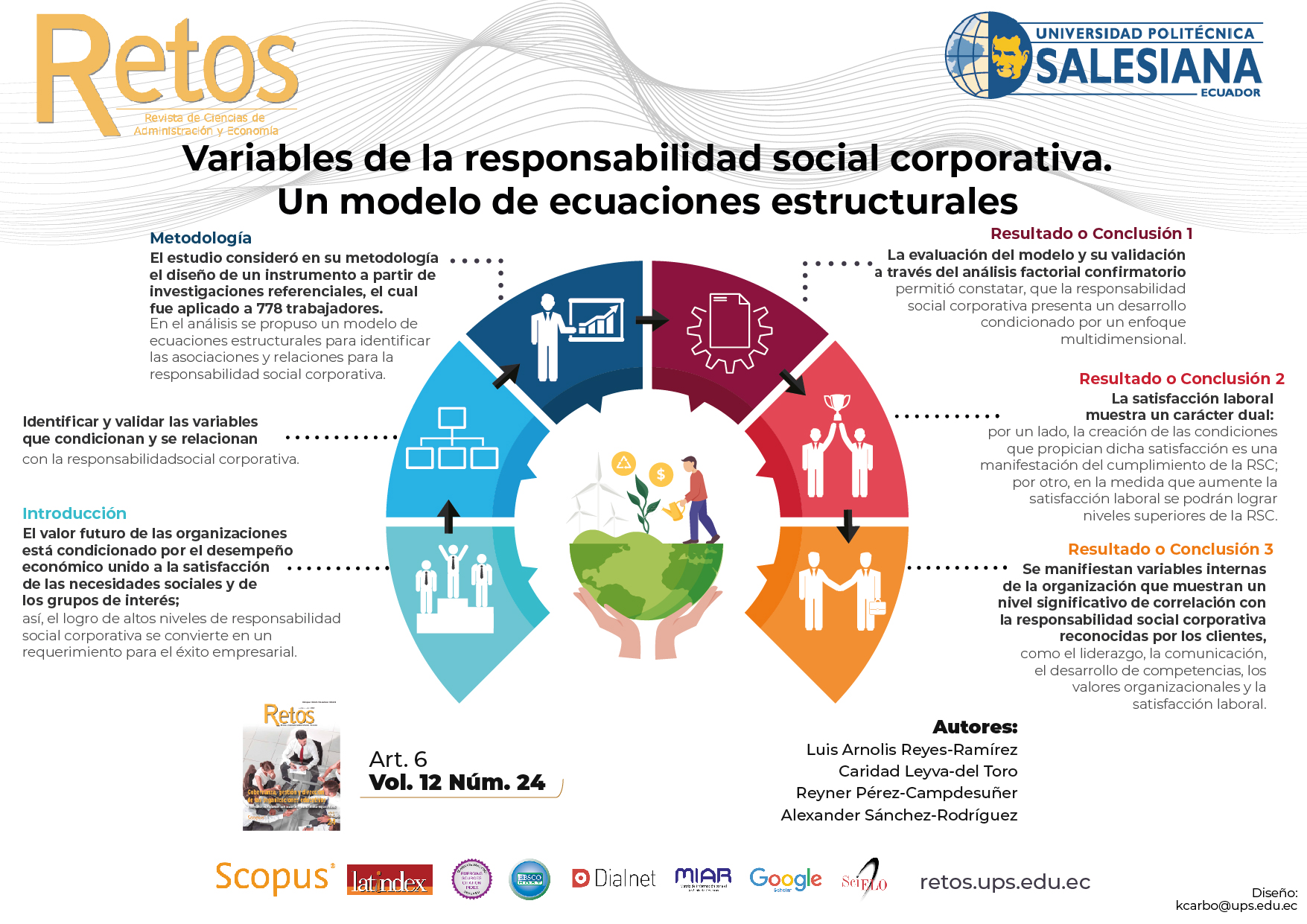
The future value of organizations depends on the economic performance linked to their level of response to social needs and interest
groups, as well as the type of relationship established with the environment in which it develops and influences. Thus, achieving high levels of
corporate social responsibility (CSR) becomes a necessity for business success. This type of research is empirical. The research was aimed at identifying and validating the variables that condition and are related to CSR. The study considered in its methodology the design of an instrument based on referential research, which was applied to 778 workers. In the analysis, a structural equation model was proposed to identify associations and relationships for CSR. The evaluation of this model of structural equations and its validation through the confirmatory factorial analysis allowed to verify, as main conclusions, that corporate social responsibility presents a development conditioned by a multidimensional approach, where internal variables of the organization are manifested that show a significant level of correlation with the CSR that the organization’s
customers recognize, such as leadership, orientation strategy, organizational design, communication, the development of labor competences, organizational values and job satisfaction, keeping a close relationship with previous research.
Article Details

This work is licensed under a Creative Commons Attribution-NonCommercial-ShareAlike 4.0 International License.
Authorship: The list of authors signing must include only those people who have contributed intellectually to the development of the work. Collaboration in the collection of data is not, by itself, a sufficient criterion of authorship. "Retos" declines any responsibility for possible conflicts arising from the authorship of the works that are published.
Copyright: The Salesian Polytechnic University preserves the copyrights of the published articles, and favors and allows their reuse under the Creative Commons Attribution-NonCommercial-ShareAlike 3.0 Ecuador license. They may be copied, used, disseminated, transmitted and publicly displayed, provided that: i) the authorship and the original source of their publication (journal, editorial and work URL) are cited; (Ii) are not used for commercial purposes; Iii) mention the existence and specifications of this license.