

Proponer un modelo de infraestructura múltiple para la utilización del bitcoin
Barra lateral del artículo
Contenido principal del artículo
Resumen
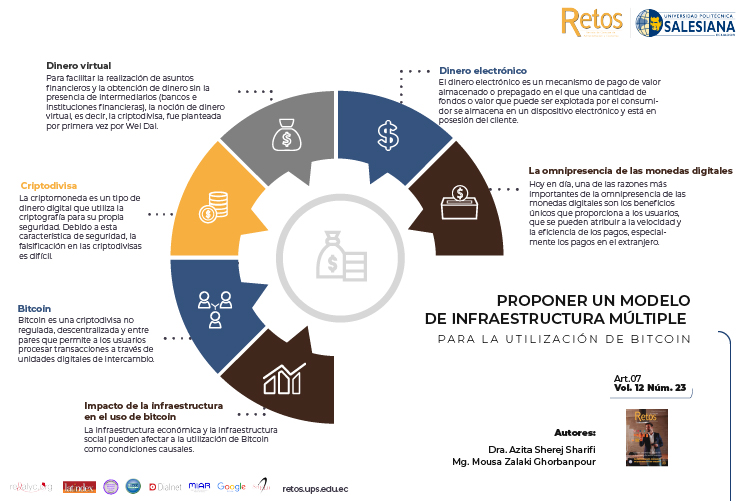
Hoy en día, una de las razones más importantes de la omnipresencia de las monedas digitales son los beneficios únicos
que brindan a los usuarios, que pueden atribuirse a la velocidad y eficiencia de los pagos, especialmente los pagos en el
extranjero. Este estudio tuvo como objetivo proporcionar un modelo de infraestructura múltiple para el uso del bitcoin.
Esta investigación se ha realizado de forma cualitativa utilizando herramientas de entrevista. La comunidad de la encuesta
está formada por expertos académicos, incluidos profesores universitarios especializados en los campos de monedas
digitales, comercio electrónico, finanzas y finanzas internacionales, y expertos empíricos formados por gerentes
y expertos de organizaciones monetarias y financieras (bancos, bolsas de valores). La selección de muestras es saturada
y propositiva. Finalmente, se seleccionaron 18 personas para responder las preguntas de la entrevista. El análisis de los
datos se realizó con el enfoque de la teoría del contexto (GT). Con base en los resultados alcanzados se obtuvieron seis
redes principales, 14 componentes principales y 77 subcomponentes como múltiples infraestructuras para el uso del
bitcoin. Los resultados también mostraron que la infraestructura económica y social puede afectar el uso del bitcoin. Si
hay fondos para comprar los dispositivos necesarios y dar la bienvenida al bitcoin en la comunidad, será más útil como
moneda digital y más aceptable.
Detalles del artículo

Esta obra está bajo una licencia internacional Creative Commons Atribución-NoComercial-CompartirIgual 4.0.
Autoría: La lista de autores firmantes debe incluir únicamente a aquellas personas que hayan contribuido intelectualmente al desarrollo del trabajo. La colaboración en la recogida de datos no es, por sí misma, criterio suficiente de autoría. "Retos" declina toda responsabilidad por posibles conflictos derivados de la autoría de los trabajos que se publiquen.
Derechos de autor: La Universidad Politécnica Salesiana preserva los derechos de autor de los artículos publicados, y favorece y permite su reutilización bajo la licencia Creative Commons Attribution-NonCommercial-ShareAlike 3.0 Ecuador. Pueden ser copiados, utilizados, difundidos, transmitidos y expuestos públicamente, siempre y cuando: i) se cite la autoría y la fuente original de su publicación (revista, editorial y URL del trabajo); (Ii) no se utilicen con fines comerciales; Iii) se mencione la existencia y especificaciones de esta licencia.
Referencias
Ballis,A.,Drakos,K.(2020). Testing for herding in the cryptocurrency market, Finance Research Letters, 33, https://doi.org/10.1016/j.frl.2019.06.008.
Bouri, E., Gupta, R. and Roubaud, D.(2019). Herdingbehaviouricryptocurrencies. Finance Research Letters., 29, 216–221.
Caporale, G. M., Gil-Alana, L. and Plastun, A.(2018). Persistence in the cryptocurrency market. Research. International. Business. Finance, 46, 141–148.
Charmaz.,K&.Thornberg.,R (2021) The pursuit of quality in grounded theory, Qualitative Research in Psychology, 18(3), 305-327.
Chuen, D. L. K. (Ed.). (2015). Handbook of digital currency: Bitcoin, innovation, financial instruments, and big data. Academic Press.
Creswell, (1998). Qualitative Inquiry and Research Design: Choosing Among Five Traditions. Sage, Thousand Oaks, CA.
Davies, P.L., Canes, M., (1978). Stock prices and the publication of second-hand information. Journal of Business, 51 (1), 43–56.
Farzin Bilandi, Ali (2017). Bitcoin, Virtual Currency, Auditor, 92, 34-36.
Ghavam, Mohammad Hossein (2018); Bitcoin: The End of Unfinished Sanctions, Growth Reflections, 1, 198-201.
Gandal, N., Hamrick, J. T., Moore, T. and Oberman, T.(2018). Price manipulation in the bitcoin ecosystem. Journal of Monetary Economics, 95, 86–96.
Gerritsen, D.F., Bouri, E., Ramezanifar, E., Roubaud, D., (2020). The profitability of technical trading rules in the Bitcoin market. Finance Research Letters 34.
Gerritsen, D.F., Lugtigheid, R. & Walther, T. (2021). Can Bitcoin Investors Profit from Predictions by Crypto Experts?, Finance Research Letters.
Haryanto, S., Subroto, A. and Ulpah, M.(2020). Disposition effect and herding behavior in the cryptocurrency market. Journal of Industrial and Business Economics., 47, 1–18.
H¨ardle, W.K., Harvey, C.R., Reule, R.C.G., (2020). Understanding cryptocurrencies. Journal of Financial Econometrics, 18 (2), 181–20.
Jack, William G. and Suri, Tavneet and Townsend, Robert M., Monetary Theory and Electronic Money: Reflections on the Kenyan Experience (2010). FRB Richmond Economic Quarterly, 96(1), 83-122.
Kahn, Charles M. and Rivadeneyra, Francisco and Wong, Tsz-Nga, Should the Central Bank Issue E-Money (2019-01-18). Available at http://dx.doi.org/doi.org/10.20955/wp.
Klein, T., Pham Thu, H., Walther, T., (2018). Bitcoin is not the New Gold–A comparison of volatility, correlation, and portfolio performance. International Review of Financial Analysis 59, 105–116.
Lo, S., & Wang, C. (2014). Bitcoin as money?: Federal Reserve Bank of Boston.
Markey, K., Tilki, M. & Taylor, G. (2020). Practicalities in doctorate research of using grounded theory methodology in understanding nurses’ behaviors when caring for culturally diverse patients, Nurse Education in Practice, 44.
Manahov,V. (2021) Cryptocurrency liquidity during extreme price movements: is there a problem with virtual money?, Quantitative Finance, 21(2)., 341-360.
Naderi, Ebrahim (2017). Bitcoin as Revolution in the Conventional System, Market and Capital, 92, 13-14.
Nasiri Ahmadabadi, Mohammad (2018). Investigating the Effect of Money and E Banking on Macroeconomics. Second World Banking Conference. Tehran: Institute of Productivity and Human Resources Studies.
Pierdzioch, C., Rülke, J.C., (2015). On the directional accuracy of forecasts of emerging market exchange rates. International Review of Economics & Finance 38, 369–376.
Petukhina, A., Trimborn, S., H¨ardle, W.K., Elendner, H(2021). Investing with cryptocurrencies – evaluating their potential for portfolio allocation strategies. Quantitative Finance.
Ramnath, S., Rock, S., Shane, P., (2008). The financial analyst forecasting literature: A taxonomy with suggestions for further research. International Journal of Forecasting 24 (1), 34–75.
Sadeghi, Hasan (2019). Bitcoin, Chamber of Commerce Letter, Year 89, 126,. 77-79.
Saiedi, E., Broström, A. & Ruiz, F. Global drivers of cryptocurrency infrastructure adoption. Small Business Economic, 57, 353–406.
Seyyed Hosseini, Mir Meisam; Doaei, Meisam; (2014), Bitcoin First Virtual Currency, Stock Exchange Magazine,115, 84-88.
Strauss, A. & Corbin, J. (1994). Grounded theory methodology: an overview, in Denzin, N. and Lincoln, Y. (Eds), Handbook of Qualitative research, N.P: Sage publications.
Sun, X. (2011). Grounded theory: theory-development in in-depth interview research. J. Xi'an Jiaot. Univ. 31(6), 87-92.
Trimborn, S., Li, Y., (2021). Informative Effects of Expert Sentiment on the Return Predictability of Cryptocurrency. https://doi.org/10.2139/ssrn.3834279.
Trimborn, S., Li, M., H¨ardle, W.K., (2019). Investing with Cryptocurrencies—a Liquidity Constrained Investment Approach. Journal of Financial Econometrics 18 (2), 280–306.
Widayat W, Masudin I, Satiti NR.(2020). E-Money Payment: Customers’ Adopting Factors and the Implication for Open Innovation. Journal of Open Innovation: Technology, Market, and Complexity,6(3),57.
Zhang, J. Ma, D. (2009). Application of Grounded Theory Method in Management, pp. 115-117, 2.