

Consumo sostenible y conciencia de las generaciones futuras en Latinoamérica
Barra lateral del artículo
Contenido principal del artículo
Resumen
Environmental challenges in Latin America demand a clearer understanding of what motivates consumers to behave sustainably.
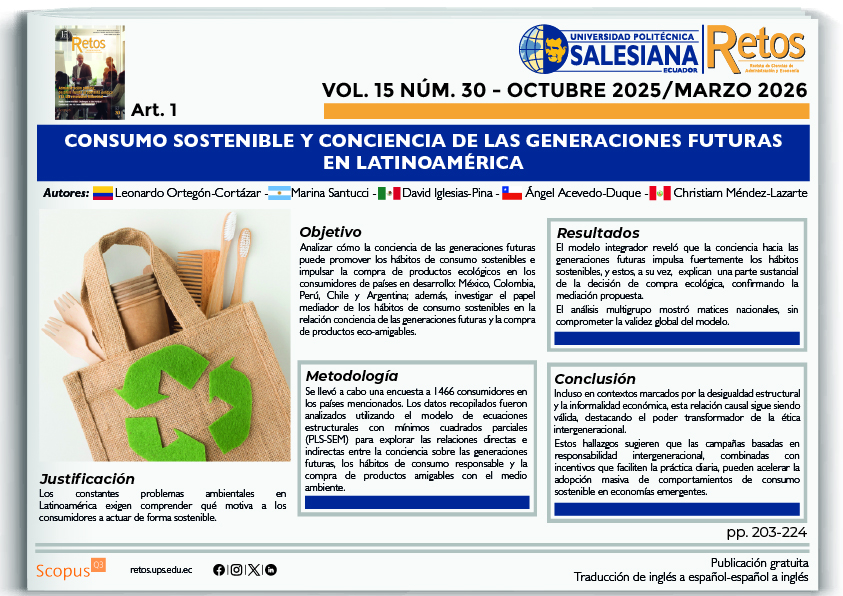
Accordingly, this study aimed to examine how future-generation awareness promotes sustainable consumption habits and drives eco-friendly purchasing among consumers in five developing countries—Mexico, Colombia, Peru, Chile, and Argentina—and, specifically, to test the mediating role of such habits in the relationship between future-generation awareness and eco-friendly buying. A survey of 1,466 consumers was conducted across the target countries. Data were analysed using partial least squares structural equation modelling (PLS-SEM) to explore the direct and indirect links between future-generation awareness, sustainable consumption habits, and eco-friendly product purchasing. The integrative model revealed that future-generation awareness strongly stimulates sustainable habits, which, in turn, account for a substantial proportion of eco-friendly purchasing behaviour, thereby confirming the proposed mediation. Multi-group analysis further uncovered country-specific nuances without undermining the global validity of the model. These findings suggest that campaigns grounded in intergenerational responsibility, combined with incentives that facilitate daily practice, can accelerate the widespread adoption of sustainable consumption behaviors in emerging economies, while also offering valuable guidance for public policy by supporting environmental regulation, fiscal incentives, and education as tools to promote sustainable consumption within institutional and governmental frameworks.
Detalles del artículo

Esta obra está bajo una licencia internacional Creative Commons Atribución-NoComercial-CompartirIgual 4.0.
Autoría: La lista de autores firmantes debe incluir únicamente a aquellas personas que hayan contribuido intelectualmente al desarrollo del trabajo. La colaboración en la recogida de datos no es, por sí misma, criterio suficiente de autoría. "Retos" declina toda responsabilidad por posibles conflictos derivados de la autoría de los trabajos que se publiquen.
Derechos de autor: La Universidad Politécnica Salesiana preserva los derechos de autor de los artículos publicados, y favorece y permite su reutilización bajo la licencia Creative Commons Attribution-NonCommercial-ShareAlike 3.0 Ecuador. Pueden ser copiados, utilizados, difundidos, transmitidos y expuestos públicamente, siempre y cuando: i) se cite la autoría y la fuente original de su publicación (revista, editorial y URL del trabajo); (Ii) no se utilicen con fines comerciales; Iii) se mencione la existencia y especificaciones de esta licencia.
Referencias
Ahmad, F., Rosli, N.T. and Quoquab, F. (2022), "Environmental quality awareness, green trust, green self-efficacy and environmental attitude in influencing green purchase behaviour", International Journal of Ethics and Systems, Vol. 38 No. 1, pp. 68-90. https://doi.org/10.1108/IJOES-05-2021-0096.
Arredondo Trapero, F.G., Maldonado de Lozada, V.D.C. and de la Garza García, J. (2010), "Consumers and their buying decision making based on price and information about corporate social responsibility (csr): Case study: Undergraduate students from a private university in Mexico", Estudios Gerenciales, Vol. 26 No. 117, pp. 103-118. https://doi.org/10.1016/S0123-5923(10)70136-4.
Bagozzi, R.P. and Yi, Y. (1988), "On the evaluation of structural equation models", Journal of the Academy of Marketing Science, Vol. 16, pp. 74-94. https://doi.org/10.1007/BF02723327.
Baron, R.M. and Kenny, D.A. (1986), "The moderator-mediator variable distinction in social psychological research: Conceptual, strategic, and statistical considerations", Journal of Personality and Social Psychology, Vol. 51 No. 6, pp. 1173-1182. https://doi.org/10.1037/0022-3514.51.6.1173.
Barahona, H. and Ortegon, L. (2024), "Impact of Business Sustainability Practices on Consumers in a VUCA Environment: An Analysis of Cleaner Production, Social Responsibility, and Eco-Innovation", in Negrón, C. (Ed.), Organizational Management Sustainability in VUCA Contexts, IGI Global, pp. 146-164.
Barros, M.V., Salvador, R., do Prado, G.F., de Francisco, A.C. and Piekarski, C.M. (2021), "Circular economy as a driver to sustainable businesses", Cleaner Environmental Systems, Vol. 2, June, 100006. https://doi.org/10.1016/j.cesys.2020.100006.
Bigné, E., Chumpitaz, R., Andreu, L. and Swaen, V. (2005), "Percepción de la responsabilidad social corporativa: un análisis cross-cultural", UCJC Business and Society Review (formerly Known As Universia Business Review), Vol. 1 No. 5. Retrieved from https://journals.ucjc.edu/ubr/article/view/516.
Borg, K., Macklin, J., Kaufman, S. and Curtis, J. (2024), "Consuming responsibly: Prioritising responsible consumption behaviours in Australia", Cleaner and Responsible Consumption, Vol. 12, 100181. DOI10.1016/j.clrc.2024.100181.
Bull, B. and Aguilar-Støen, M. (2014), "Environmental governance and sustainable development in Latin America", in Bull, B. and Aguilar-Støen, M. (Eds.), Environmental Politics in Latin America, Routledge, pp. 1-14.
Chin, W.W. (1998), "The partial least squares approach to structural equation modeling", in Marcoulides, G.A. (Ed.), Modern Methods for Business Research, Lawrence Erlbaum Associates, London, Vol. 295 No. 2, pp. 295-336.
Chin, W.W. (2009), "How to write up and report PLS analyses", in Esposito Vinzi, V., Chin, W.W., Henseler, J. and Wang, H. (Eds.), Handbook of Partial Least Squares: Concepts, Methods and Applications, Springer, Berlin, Heidelberg, pp. 655-690.
Chin, W.W. and Dibbern, J. (2009), "An introduction to a permutation based procedure for multi-group PLS analysis: Results of tests of differences on simulated data and a cross-cultural analysis of the sourcing of information system services between Germany and the USA", in Esposito Vinzi, V., Chin, W.W., Henseler, J. and Wang, H. (Eds.), Handbook of Partial Least Squares: Concepts, Methods and Applications, Springer, Berlin, Heidelberg, pp. 171-193.
Cristancho-Triana, G. J., Cancino-Gómez, Y. A., & Ninco-Hernández, F. A. (2024). Factores que influyen en el comportamiento de consumo sostenible en la generación Z. RETOS. Revista de Ciencias de la Administración y Economía, 14(27), 51-67.
Davies, H. (2016). The well-being of future generations (Wales) act 2015: duties or aspirations?. Environmental Law Review, 18(1), 41-56.
De Carvalho, M.C.R., Sobreiro, V.A., Kimura, H. and de Moraes Barboza, F.L. (2016), "A systematic review of literature about finance and sustainability", Journal of Sustainable Finance & Investment, Vol. 6 No. 2, pp. 112-147. https://doi.org/10.1080/20430795.2016.1177438.
Dionela, T., Evangelista, A., Lansang, C. M., & Sato, M. V. U. (2022). Sustainable marketing: Studying the effects of environmental consciousness and involvement degree on purchasing behavior of consumers. Journal of Business and Management Studies, 4(1), 213-221.
Dijkstra, T.K. and Henseler, J. (2015), "Consistent and asymptotically normal PLS estimators for linear structural equations", Computational Statistics & Data Analysis, Vol. 81, pp. 10-23. https://doi.org/10.1016/j.csda.2014.07.008.
Dimitrova, T., Ilieva, I. and Angelova, M. (2022), "Exploring factors affecting sustainable consumption behaviour", Administrative Sciences, Vol. 12 No. 4, 155. https://doi.org/10.3390/admsci12040155.
Erikson, E. (1950), Childhood and Society, Norton, New York, pp. 426-442.
Feldman, P.M. and Reficco, E. (2015), "Impacto de la responsabilidad social empresarial en el comportamiento de compra y disposición a pagar de consumidores bogotanos", Estudios Gerenciales, Vol. 31 No. 137, pp. 373-382. https://doi.org/10.1016/j.estger.2015.10.001.
Fischer, D., Böhme, T. and Geiger, S.M. (2017), "Measuring young consumers’ sustainable consumption behavior: Development and validation of the YCSCB scale", Young Consumers, Vol. 18 No. 3, pp. 312-326.
Fornell, C. and Larcker, D.F. (1981), "Evaluating structural equation models with unobservable variables and measurement error", Journal of Marketing Research, Vol. 18 No. 1, pp. 39-50. https://doi.org/10.1177/002224378101800104.
Galiano Coronil, A., y Ortega Gil, M. (2019). Marketing social, indicadores de bienestar y ODS. Análisis de @desdelamoncloa. Retos Revista de Ciencias de la Administración y Economía, 9(18), 219-238. https://doi.org/10.17163/ret.n18.2019.03
Gatersleben, B., Murtagh, N. and Abrahamse, W. (2014), "Values, identity and pro-environmental behaviour", Contemporary Social Science, Vol. 9 No. 4, pp. 374-392. https://doi.org/10.1080/21582041.2012.682086.
Gillan, S.L., Koch, A. and Starks, L.T. (2021), "Firms and social responsibility: A review of ESG and CSR research in corporate finance", Journal of Corporate Finance, Vol. 66, 101889. https://doi.org/10.1016/j.jcorpfin.2021.101889.
Gomes, S. and Lopes, J.M. (2024), "Unlocking the potential of circular consumption: The influence of circular habits, environmental concerns and the search for pro-sustainable information on circular consumption", Business Strategy & Development, Vol. 7 No. 1, e327. DOI10.1002/bsd2.327.
Hair, J.F., Risher, J.J., Sarstedt, M. and Ringle, C.M. (2019), "When to use and how to report the results of PLS-SEM", European Business Review, Vol. 31 No. 1, pp. 2-24.
Hair, J.F., Astrachan, C.B., Moisescu, O.I., Radomir, L., Sarstedt, M., Vaithilingam, S. and Ringle, C.M. (2021), "Executing and interpreting applications of PLS-SEM: Updates for family business researchers", Journal of Family Business Strategy, Vol. 12 No. 3, 100392. https://doi.org/10.1016/j.jfbs.2020.100392.
Henseler, J., Ringle, C.M. and Sarstedt, M. (2016), "Testing measurement invariance of composites using partial least squares", International Marketing Review, Vol. 33 No. 3, pp. 405-431. https://doi.org/10.1108/IMR-09-2014-0304.
Henseler, J. and Sarstedt, M. (2013), "Goodness-of-fit indices for partial least squares path modeling", Computational Statistics, Vol. 28, pp. 565-580. https://doi.org/10.1007/s00180-012-0317-1.
Henseler, J., Ringle, C. M., & Sarstedt, M. (2015). A new criterion for assessing discriminant validity in variance-based structural equation modeling. Journal of the academy of marketing science, 43, 115-135. https://doi.org/10.1007/s11747-014-0403-8
Ibañez-Gaona, D., Sánchez, L.P., Cortázar, L.O. and Lazarte, C.M. (2022), "Motivaciones de comercialización y del consumo sostenible en la industria de prendas de vestir", Punto de vista, Vol. 13 No. 20, pp. 36-46.
Jain, V.K., Dahiya, A., Tyagi, V. and Sharma, P. (2023), "Development and validation of scale to measure responsible consumption", Asia-Pacific Journal of Business Administration, Vol. 15 No. 5, pp. 795-814. DOI10.1108/APJBA-12-2020-0460.
Kline, R.B. (2023), Principles and Practice of Structural Equation Modeling, 5th ed., Guilford Publications, New York.
Kumar, N., Kaliyan, M., Thilak, M. and Acevedo-Duque, Á. (2021), "Identification of specific metrics for sustainable lean manufacturing in the automobile industries", Benchmarking: An International Journal, Vol. ahead-of-print No. ahead-of-print. https://doi.org/10.1108/BIJ-04-2021-0190.
Lange, F. (2024), "What is measured in pro-environmental behavior research?", Journal of Environmental Psychology, 102381. https://doi.org/10.1016/j.jenvp.2023.102381.
Lavuri, R. (2022), "Extending the theory of planned behavior: factors fostering millennials’ intention to purchase eco-sustainable products in an emerging market", Journal of Environmental Planning and Management, Vol. 65 No. 8, pp. 1507-1529. https://doi.org/10.1080/09640568.2021.1962038.
Liengaard, B.D., Sharma, P.N., Hult, G.T.M., Jensen, M.B., Sarstedt, M., Hair, J.F. and Ringle, C.M. (2021), "Prediction: Coveted, yet forsaken? Introducing a cross-validated predictive ability test in partial least squares path modeling", Decision Sciences, Vol. 52 No. 2, pp. 362-392. https://doi.org/10.1111/deci.12416.
Luciano, A., Cutaia, L., Cioffi, F. and Sinibaldi, C. (2021), "Demolition and construction recycling unified management: The DECORUM platform for improvement of resource efficiency in the construction sector", Environmental Science and Pollution Research, Vol. 28, pp. 24558-24569. DOI10.1007/s11356-020-09513-6.
Luna, M.E.O. and Arce, J.O. (2022), "Circular challenge: Education for the creation of a zero waste world", IEEE Global Engineering Education Conference (EDUCON), pp. 1583-1586. DOI10.1109/EDUCON52537.2022.9766720.
Maldovan, J. (2018), "Environmental protection, work, and social inclusion: Formalizing the recycling of urban solid waste in Buenos Aires", Latin American Perspectives, Vol. 45 No. 1, pp. 91-107. https://doi.org/10.1177/0094582X17730372.
McAdams, D.P. and de St Aubin, E.D. (1992), "A theory of generativity and its assessment through self-report, behavioral acts, and narrative themes in autobiography", Journal of Personality and Social Psychology, Vol. 62 No. 6, pp. 1003-1015. https://doi.org/10.1037/0022-3514.62.6.1003.
Mejía-Giraldo, J. F. (2020). Relación entre el principio de reciprocidad y el compromiso del consumidor. RETOS. Revista de Ciencias de la Administración y Economía, 10(20), 249-264. https://doi.org/10.17163/ret.n20.2020.04
Miles, M.P. and Munilla, L.S. (2004), "The potential impact of social accountability certification on marketing: A short note", Journal of Business Ethics, Vol. 50, pp. 1-11. https://doi.org/10.1023/B:BUSI.0000021139.94166.74.
Müller-Pérez, J., Acevedo-Duque, Á., Rettig, P.V., García-Salirrosas, E.E., Fernández-Mantilla, M.M., Izquierdo-Marín, S.S. and Álvarez-Becerra, R. (2023), "Consumer behavior after COVID-19: Interpersonal influences, eWOM and digital lifestyles in more diverse youths", Sustainability, Vol. 15 No. 8, 6570. https://doi.org/10.3390/su15086570.
Nguyen, H.V., Le, M.T.T., Pham, C.H. and Cox, S.S. (2024), "Happiness and pro-environmental consumption behaviors", Journal of Economics and Development, Vol. 26 No. 1, pp. 36-49. https://doi.org/10.1108/JED-06-2023-0087.
Ospina-Mateus, H., Marrugo-Salas, L., Castilla, L.C., Castellón, L., Cantillo, A., Bolivar, L.M. ... and Zamora-Musa, R. (2023), "Analysis in circular economy research in Latin America: A bibliometric review", Heliyon, e19999. https://doi.org/10.1016/j.heliyon.2023.e19999.
Pacheco-Rueda, M. and Pastor-Rodríguez, A. (2023), "Generando conciencia ecológica desde la universidad. Análisis de una experiencia en torno a moda y sostenibilidad con futuros profesionales de la publicidad", Revista de Comunicación, Vol. 22 No. 2, pp. 435-455. DOI10.26441/RC22.2-2023-3250.
Palacios-Chavarro, J.A., Marroquín-Ciendúa, F. and Bohórquez-Lazdhaluz, R. (2021), "Social campaigns to encourage responsible fashion consumption", Communication & Society, Vol. 34 No. 3, pp. 153-169. DOI10.15581/003.34.3.153-168.
Paužuolienė, J., Šimanskienė, L. and Fiore, M. (2022), "What about responsible consumption? A survey focused on food waste and consumer habits", Sustainability, Vol. 14 No. 14, 8509. DOI10.3390/su14148509.
Pinto, D.C., Nique, W.M., Añaña, E.D.S. and Herter, M.M. (2011), "Green consumer values: How do personal values influence environmentally responsible water consumption?", International Journal of Consumer Studies, Vol. 35 No. 2, pp. 122-131. DOI10.1111/j.1470-6431.2010.00962.x.
Pires, C.M., Moura-Leite, R.C., Pereira, M.W.G. and Tang-Serquen, I. (2020), "Corporate social responsibility from the consumer perspective: A cross-cultural study", Brazilian Journal of Marketing, Vol. 19 No. 2, pp. 334-360. https://doi.org/10.5585/remark.v19i2.17773.
Podsakoff, P. M., MacKenzie, S. B., Lee, J. Y., & Podsakoff, N. P. (2003). Common method biases in behavioral research: a critical review of the literature and recommended remedies. Journal of applied psychology, 88(5), 879. https://psycnet.apa.org/doi/10.1037/0021-9010.88.5.879
Preacher, K.J. and Hayes, A.F. (2008), "Asymptotic and resampling strategies for assessing and comparing indirect effects in multiple mediator models", Behavior Research Methods, Vol. 40 No. 3, pp. 879-891. https://doi.org/10.3758/BRM.40.3.879.
Quispe Palomino, A. and Quispe Huisa, V. (2021), "Reutilización y reciclaje de residuos sólidos en economías emergentes en Latinoamérica: una revisión sistemática", Ciencia Latina Revista Científica Multidisciplinar, Vol. 5 No. 6, pp. 13184-13202. https://doi.org/10.37811/cl_rcm.v5i6.1316.
Quoquab, F. and Mohammad, J. (2020), "Cognitive, affective and conative domains of sustainable consumption: Scale development and validation using confirmatory composite analysis", Sustainability, Vol. 12 No. 18, 7784. https://doi.org/10.3390/su12187784.
Quoquab, F., Mohammad, J. and Sukari, N.N. (2019), "A multiple-item scale for measuring 'sustainable consumption behaviour' construct: Development and psychometric evaluation", Journal of Cleaner Production, Vol. 241, 118263. https://doi.org/10.1016/j.jclepro.2019.118263.
Rajak, S., Vimal, K.E.K., Arumugam, S. et al. (2022), "Multi-objective mixed-integer linear optimization model for sustainable closed-loop supply chain network: A case study on remanufacturing steering column", Environmental Development and Sustainability, Vol. 24, pp. 6481-6507. https://doi.org/10.1007/s10668-021-01713-5.
Ramírez González, D.E., Ortegón Cortázar, L. and Soler Mahecha, C. (2023), "Consumir moda lenta: ¿cómo la exclusividad y la equidad promueven el comportamiento de compra de moda sostenible?", Estudios Gerenciales, Vol. 39 No. 169, pp. 404-416. https://doi.org/10.18046/j.estger.2023.169.5297.
Robinot, E., Ertz, M. and Durif, F. (2017), "Jingle bells or 'green' bells? The impact of socially responsible consumption principles upon consumer behaviour at Christmas time", International Journal of Consumer Studies, Vol. 41 No. 6, pp. 605-617. DOI10.1111/ijcs.12373.
Saari, U.A., Damberg, S., Frömbling, L. and Ringle, C.M. (2021), "Sustainable consumption behavior of Europeans: The influence of environmental knowledge and risk perception on environmental concern and behavioral intention", Ecological Economics, Vol. 189, 107155. https://doi.org/10.1016/j.ecolecon.2021.107155.
Sánchez, M. del P., Cruz, J.G. and Maldonado, P.C. (2020), "Gestión de residuos sólidos urbanos en América Latina: Un análisis desde la perspectiva de la generación", Revista Finanzas y Política Económica, Vol. 11 No. 2, pp. 321-336. https://doi.org/10.14718/revfinanzpolitecon.2019.11.2.6.
Santucci, M., Días, A., Sotomayor, S. and Carro, B. (2023), "Factores motivacionales en modelos sostenibles de la industria de la moda", Pymes, Innovación y Desarrollo, Vol. 11 No. 1, pp. 3-23. Retrieved from https://revistas.unc.edu.ar/index.php/pid/article/view/41358.
Sarstedt, M., Henseler, J., & Ringle, C. M. (2011). Multigroup analysis in partial least squares (PLS) path modeling: Alternative methods and empirical results. In Measurement and research methods in international marketing (pp. 195-218). Emerald Group Publishing Limited.
Sarstedt, M., Radomir, L., Moisescu, O.I. and Ringle, C.M. (2022), "Latent class analysis in PLS-SEM: A review and recommendations for future applications", Journal of Business Research, Vol. 138, pp. 398-407. https://doi.org/10.1016/j.jbusres.2021.09.045.
Sharma, P.N., Liengaard, B.D., Hair, J.F., Sarstedt, M. and Ringle, C.M. (2022), "Predictive model assessment and selection in composite-based modeling using PLS-SEM: Extensions and guidelines for using CVPAT", European Journal of Marketing, Vol. 57 No. 6, pp. 1662-1677. https://doi.org/10.1108/EJM-09-2021-0640.
Shmueli, G., Sarstedt, M., Hair, J.F., Cheah, J.H., Ting, H., Vaithilingam, S. and Ringle, C.M. (2019), "Predictive model assessment in PLS-SEM: Guidelines for using PLSpredict", European Journal of Marketing, Vol. 53 No. 11, pp. 2322-2347. https://doi.org/10.1108/EJM-02-2019-0189.
Schwartz, S.H. (1977), "Normative influences on altruism", in Berkowitz, L. (Ed.), Advances in Experimental Social Psychology, Vol. 10, pp. 221-279. https://doi.org/10.1016/S0065-2601(08)60358-5.
Severo, E.A., de Guimarães, J.C.F. and Dorion, E.C.H. (2018), "Cleaner production, social responsibility and eco-innovation: Generations' perception for a sustainable future", Journal of Cleaner Production, Vol. 186, pp. 91-103. https://doi.org/10.1016/j.jclepro.2018.03.129.
Severo, E.A., de Guimarães, J.C.F. and Dellarmelin, M.L. (2021), "Impact of the COVID-19 pandemic on environmental awareness, sustainable consumption and social responsibility: Evidence from generations in Brazil and Portugal", Journal of Cleaner Production, Vol. 286, 124947. https://doi.org/10.1016/j.jclepro.2020.124947.
Seyfang, G. (2013), "Shopping for sustainability: Can sustainable consumption promote ecological citizenship?", in Gabrielson, T., Hall, C., Meyer, J.M. and Schlosberg, D. (Eds.), Citizenship, Environment, Economy, Routledge, pp. 137-153. https://doi.org/10.4324/9781315879086-10.
Syropoulos, S. and Markowitz, E.M. (2022), "Perceived responsibility to address climate change consistently relates to increased pro-environmental attitudes, behaviors and policy support: Evidence across 23 countries", Journal of Environmental Psychology, Vol. 83, 101868. https://doi.org/10.1016/j.jenvp.2022.101868.
Thøgersen, J. and Noblet, C. (2012), "Does green consumerism increase the acceptance of wind power?", Energy Policy, Vol. 51, pp. 854-862. https://doi.org/10.1016/j.enpol.2012.09.044.
Triana, G.J.C. and Hernandez, F.A.N. (2023), "El consumo responsable y su influencia en las actividades de reciclaje en el hogar: Un estudio exploratorio", Revista Virtual Universidad Católica del Norte, Vol. 69, pp. 190-220. DOI10.35575/rvucn.n69a8.
Tunn, V.S., Bocken, N.M., van den Hende, E.A. and Schoormans, J.P. (2019), "Business models for sustainable consumption in the circular economy: An expert study", Journal of Cleaner Production, Vol. 212, pp. 324-333. https://doi.org/10.1016/j.jclepro.2018.11.290.
Ulusoy, E. (2016), "Experiential responsible consumption", Journal of Business Research, Vol. 69 No. 1, pp. 284-297. DOI10.1016/j.jbusres.2015.07.041.
Valenzuela-Fernández, L., Guerra-Velásquez, M., Escobar-Farfán, M. and García-Salirrosas, E.E. (2022), "Influence of COVID-19 on environmental awareness, sustainable consumption, and social responsibility in Latin American countries", Sustainability, Vol. 14 No. 19, 12754. https://doi.org/10.3390/su141912754.
Webb, D.J., Mohr, L.A. and Harris, K.E. (2008), "A re-examination of socially responsible consumption and its measurement", Journal of Business Research, Vol. 61 No. 2, pp. 91-98. DOI10.1016/j.jbusres.2007.05.007.