

Comportamiento de compra impulsiva en Instagram entre las generaciones Y y Z en Indonesia
Barra lateral del artículo
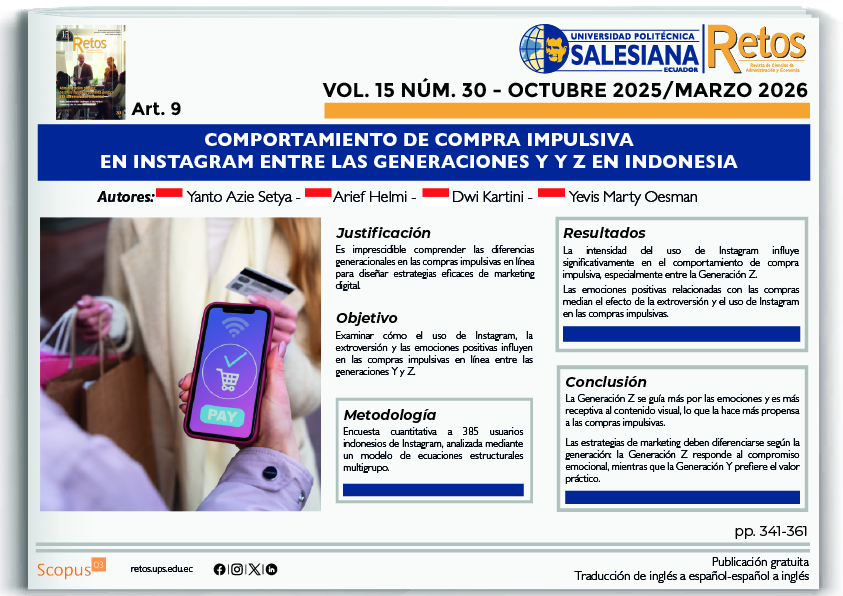
Contenido principal del artículo
Resumen
Instagram se ha convertido en una importante plataforma para las compras en línea, especialmente entre la generación más joven.
Comprender los factores que influyen en las compras impulsivas en las redes sociales resulta cada vez más importante para los profesionales del marketing. Este estudio examina la influencia del uso de Instagram, la extroversión y las emociones positivas relacionadas con las compras en el comportamiento de compra impulsiva, con énfasis en las diferencias generacionales entre la Generación Y y la Generación Z. Se recopilaron datos de 442 encuestados mediante un cuestionario estructurado y se analizaron con SmartPLS 3.3.2 para comprobar seis hipótesis. Se evaluaron la validez y la fiabilidad mediante el alfa de Cronbach, al igual que la fiabilidad compuesta y la extracción de la varianza media (AVE). Los resultados revelan que, para la Generación Z, el uso frecuente de Instagram y las emociones positivas impulsan significativamente las compras impulsivas. Por el contrario, para la Generación Y, los rasgos de personalidad extrovertida tienen una mayor influencia en las decisiones de compra. Estos resultados muestran los patrones psicológicos entre generaciones en el comportamiento de compra online. El estudio ofrece información práctica a los profesionales del marketing que buscan adaptar sus estrategias para satisfacer las preferencias generacionales. El poder identificar los diferentes factores que impulsan el comportamiento contribuye a la creciente bibliografía sobre el comportamiento del consumidor digital y sirve de guía a las marcas que operan en entornos de redes sociales.
Detalles del artículo

Esta obra está bajo una licencia internacional Creative Commons Atribución-NoComercial-CompartirIgual 4.0.
Autoría: La lista de autores firmantes debe incluir únicamente a aquellas personas que hayan contribuido intelectualmente al desarrollo del trabajo. La colaboración en la recogida de datos no es, por sí misma, criterio suficiente de autoría. "Retos" declina toda responsabilidad por posibles conflictos derivados de la autoría de los trabajos que se publiquen.
Derechos de autor: La Universidad Politécnica Salesiana preserva los derechos de autor de los artículos publicados, y favorece y permite su reutilización bajo la licencia Creative Commons Attribution-NonCommercial-ShareAlike 3.0 Ecuador. Pueden ser copiados, utilizados, difundidos, transmitidos y expuestos públicamente, siempre y cuando: i) se cite la autoría y la fuente original de su publicación (revista, editorial y URL del trabajo); (Ii) no se utilicen con fines comerciales; Iii) se mencione la existencia y especificaciones de esta licencia.
Referencias
Alves, P., Martins, H., Saraiva, P., Carneiro, J., Novais, P., & Marreiros, G. (2023). Group recommender systems for tourism: how does personality predict preferences for attractions, travel motivations, preferences and concerns? User Modeling and User-Adapted Interaction, 33(5), 1141–1210. https://doi.org/10.1007/s11257-023-09361-2
Amiri, F., Jasour, J., Shirpour, M., & Alizadeh, T. (2012). Evaluation of effective fashionism involvement factors effects on impulse buying of customers and condition of interrelation between these factors. Journal of Basic and Applied Scientific Research, 2(9), 9413–9419.
Appel, G., Grewal, L., Hadi, R., & Stephen, A. T. (2020). The future of social media in marketing. Journal of the Academy of Marketing Science, 48(1), 79–95. https://doi.org/10.1007/s11747-019-00695-1
Bijari, B., Javadinia, S. A., Erfanian, M., Abedini, M., & Abassi, A. (2013). The impact of virtual social networks on students’ academic achievement in Birjand University of Medical Sciences in East Iran. Procedia-Social and Behavioral Sciences, 83, 103–106.
Bosnjak, M., Galesic, M., & Tuten, T. (2007). Personality determinants of online shopping: Explaining online purchase intentions using a hierarchical approach. Journal of Business Research, 60(6), 597–605.
Brand, B. M., Rausch, T. M., & Brandel, J. (2022). The importance of sustainability aspects when purchasing online: comparing generation X and generation Z. Sustainability, 14(9), 5689.
Bratko, D., Butkovic, A., & Bosnjak, M. (2013). Twin study of impulsive buying and its overlap with personality. Journal of Individual Differences.
Chan, T. K. H., Cheung, C. M. K., & Lee, Z. W. Y. (2017). The state of online impulse-buying research: A literature analysis. Information & Management, 54(2), 204–217.
Djafarova, E., & Rushworth, C. (2017). Exploring the credibility of online celebrities’ Instagram profiles in influencing the purchase decisions of young female users. Computers in Human Behavior, 68, 1–7.
Dobre, C., Milovan, A. M., Duțu, C., Preda, G., & Agapie, A. (2021). The common values of social media marketing and luxury brands. The millennials and generation z perspective. Journal of Theoretical and Applied Electronic Commerce Research, 16(7), 2532–2553. https://doi.org/10.3390/jtaer16070139
Dwivedi, Y. K., Ismagilova, E., Hughes, D. L., Carlson, J., Filieri, R., Jacobson, J., Jain, V., Karjaluoto, H., Kefi, H., Krishen, A. S., Kumar, V., Rahman, M. M., Raman, R., Rauschnabel, P. A., Rowley, J., Salo, J., Tran, G. A., & Wang, Y. (2021). Setting the future of digital and social media marketing research: Perspectives and research propositions. International Journal of Information Management, 59(July 2020), 102168. https://doi.org/10.1016/j.ijinfomgt.2020.102168
Gonzalez, E., Leidner, D., Riemenschneider, C., & Koch, H. (2013). The impact of internal social media usage on organizational socialization and commitment.
Gupta, S., Kushwaha, P. S., Badhera, U., Chatterjee, P., & Gonzalez, E. D. R. S. (2023). Identification of benefits, challenges, and pathways in E-commerce industries: An integrated two-phase decision-making model. Sustainable Operations and Computers, 4, 200–218.
Helmi, A., Oesman, Y. M., Kaltum, U., & Faisal, Y. A. (2023). The influence of hedonic values and extraversion on online impulse buying: Empirical evidence from Indonesia. Innovative Marketing, 19(1), 48.
Hendrawan, D., & Nugroho, D. A. (2018). Influence of personality on impulsive buying behaviour among Indonesian young consumers. International Journal of Trade and Global Markets, 11(1–2), 31–39.
Hoang, D., Kousi, S., & Martinez, L. F. (2023). Online customer engagement in the post-pandemic scenario: a hybrid thematic analysis of the luxury fashion industry. Electronic Commerce Research, 23(3), 1401–1428.
Huang, J.-H., & Yang, Y.-C. (2010). The relationship between personality traits and online shopping motivations. Social Behavior and Personality: An International Journal, 38(5), 673–679.
Huang, L.-T. (2016). Flow and social capital theory in online impulse buying. Journal of Business Research, 69(6), 2277–2283.
Hurdawaty, R., Wibowo, F. X. S., & Sulistiyowaty, R. (2023). Studying the Consumption Behaviour of Generations Y and Z towards Ready-To-Drink Coffee. International Journal of Travel, Hospitality and Events, 2(1), 10–26.
Isen, A. M. (1984). The Influence of Positive Affect on Decision Making and Cognitive Organization. Advances in Consumer Research, 11(1).
Iyer, E. S. (1989). Unplanned Purchasing: Knowledge of shopping environment and. Journal of Retailing, 65(1), 40.
Jin, S.-A. A., & Phua, J. (2014). Following celebrities’ tweets about brands: The impact of twitter-based electronic word-of-mouth on consumers’ source credibility perception, buying intention, and social identification with celebrities. Journal of Advertising, 43(2), 181–195.
Joo Park, E., Young Kim, E., & Cardona Forney, J. (2006). A structural model of fashion‐oriented impulse buying behavior. Journal of Fashion Marketing and Management: An International Journal, 10(4), 433–446.
Khan, N., Hui, L. H., Chen, T. B., & Hoe, H. Y. (2016). Impulse buying behaviour of generation Y in fashion retail. International Journal of Business and Management, 11(1), 144.
Kirschner, P. A., & Karpinski, A. C. (2010). Facebook® and academic performance. Computers in Human Behavior, 26(6), 1237–1245.
Koski, N., & Mesiranta, N. (2005). Impulse buying on the internet: encouraging and discouraging factors. In Frontiers of e-Business Research (FeBR) 2004 (pp. 23–35). Tampere University of Technology and University of Tampere.
Krbová, P. K. (2016). Shopping behaviour of generation Y: A comparison of Czech Republic and Slovakia. Acta Universitatis Agriculturae et Silviculturae Mendelianae Brunensis, 64(2), 617–626.
Kristi, G. O., & Aruan, D. T. H. (2023). Factors Affecting Online Impulse Buying Behavior of Fashion Products on Live: Instagram Vs Tiktok. Indonesian Interdisciplinary Journal of Sharia Economics, 6(3), 2163–2185.
Lajnef, K. (2023). The effect of social media influencers’ on teenagers behavior: An empirical study using cognitive map technique. Current Psychology, 42(22), 19364–19377.
Lee, C.-H., & Wu, J. J. (2017). Consumer online flow experience: The relationship between utilitarian and hedonic value, satisfaction and unplanned purchase. Industrial Management & Data Systems, 117(10), 2452–2467.
Nahai, N. (2017). Webs of Influence: The Psychology Of Online Persuasion. Pearson Business
Priporas, C.-V., Stylos, N., & Fotiadis, A. K. (2017). Generation Z consumers’ expectations of interactions in smart retailing: A future agenda. Computers in Human Behavior, 77, 374–381.
Rezaei, S., Ali, F., Amin, M., & Jayashree, S. (2016). Online impulse buying of tourism products: The role of web site personality, utilitarian and hedonic web browsing. Journal of Hospitality and Tourism Technology, 7(1), 60–83.
Robert, D., & John, R. (1982). Store atmosphere: an environmental psychology approach. Journal of Retailing, 58(1), 34–57.
Rook, D. W., & Gardner, M. P. (1993). In the mood: Impulse buying’s affective antecedents. Research in Consumer Behavior, 6(7), 1–28.
Rowley, J. (2002). Using case studies in research. Management Research News, 25(1), 16–27.
Stern, H. (1962). The significance of impulse buying today. Journal of Marketing, 26(2), 59–62.
Sudirjo, F., Lotte, L. N. A., Sutaguna, I. N. T., Risdwiyanto, A., & Yusuf, M. (2023). The Influence of Generation Z Consumer Behavior on Purchase Motivation in E-Commerce Shoppe. Profit: Jurnal Manajemen, Bisnis Dan Akuntansi, 2(2), 110–126.
Thomas, M. R., & Monica, M. (2018). Online website cues influencing the purchase intention of generation z mediated by trust. Indian Journal of Commerce and Management Studies, 9(1), 13–23.
Thompson, E. R., & Prendergast, G. P. (2015). The influence of trait affect and the five-factor personality model on impulse buying. Personality and Individual Differences, 76, 216–221.
Turkyilmaz, C. A., Erdem, S., & Uslu, A. (2015). The effects of personality traits and website quality on online impulse buying. Procedia-Social and Behavioral Sciences, 175, 98–105.
Verhagen, T., & Van Dolen, W. (2011). The influence of online store beliefs on consumer online impulse buying: A model and empirical application. Information & Management, 48(8), 320–327.
Weinberg, P., & Gottwald, W. (1982). Impulsive consumer buying as a result of emotions. Journal of Business Research, 10(1), 43–57.
Wilcox, K., & Stephen, A. T. (2013). Are close friends the enemy? Online social networks, self-esteem, and self-control. Journal of Consumer Research, 40(1), 90–103.
Zhang, K. Z. K., Xu, H., Zhao, S., & Yu, Y. (2018). Online reviews and impulse buying behavior: the role of browsing and impulsiveness. Internet Research, 28(3), 522–543.
Zhao, Y., Li, Y., Wang, N., Zhou, R., & Luo, X. (2022). A meta-analysis of online impulsive buying and the moderating effect of economic development level. Information Systems Frontiers, 24(5), 1667–1688.