

Influencia del liderazgo transaccional y transformacional en el desempeño social, ambiental y operativo
Barra lateral del artículo
Contenido principal del artículo
Resumen
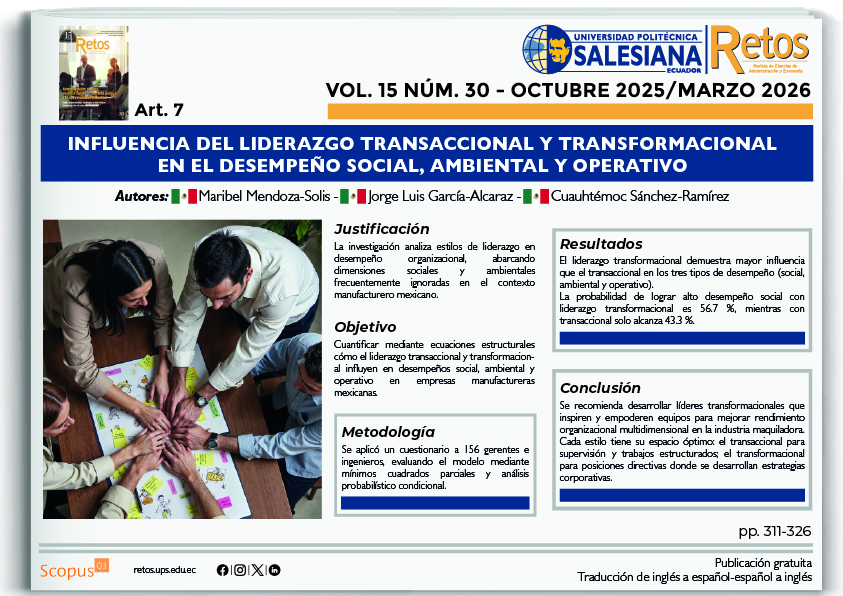
El estilo de liderazgo de los administradores influye en el desempeño de las empresas que dirigen; sin embargo, la mayoría de los estudios se enfocan en relacionarlo con el desempeño económico y operativo, ignorando aspectos sociales y ambientales. Este estudio reporta un modelo de ecuaciones estructurales que relaciona el liderazgo transaccional y transformacional como variables independientes con el desempeño social, operativo y ambiental como variables dependientes mediante seis hipótesis para cuantificar la relación entre esas variables. Para validar las hipótesis en el modelo, se diseña y aplica un cuestionario a administradores de procesos productivos de la industria maquiladora mexicana. Se obtuvieron 156 cuestionarios válidos, cuya información fue capturada en el software SPSS v.24 para su depuración y validación. El modelo fue evaluado con el enfoque de mínimos cuadrados y reporta un análisis de sensibilidad basado en probabilidades condicionales para escenarios de ocurrencia altos y bajos en las variables. Los resultados indican que los estilos de liderazgo transaccional y transformacional influyen positivamente en el rendimiento social, operativo y ambiental de las empresas. Sin embargo, el liderazgo transformacional tiene un mayor impacto que el transaccional en cada desempeño los tres tipos de desempeño medidos, por lo que se concluye que, debido a la naturaleza de la industria maquiladora, es mejor invertir recursos en desarrollar líderes transformacionales que tengan mayor visión e inspiración, empoderen, motiven y desarrollen a su personal.
Detalles del artículo

Esta obra está bajo una licencia internacional Creative Commons Atribución-NoComercial-CompartirIgual 4.0.
Autoría: La lista de autores firmantes debe incluir únicamente a aquellas personas que hayan contribuido intelectualmente al desarrollo del trabajo. La colaboración en la recogida de datos no es, por sí misma, criterio suficiente de autoría. "Retos" declina toda responsabilidad por posibles conflictos derivados de la autoría de los trabajos que se publiquen.
Derechos de autor: La Universidad Politécnica Salesiana preserva los derechos de autor de los artículos publicados, y favorece y permite su reutilización bajo la licencia Creative Commons Attribution-NonCommercial-ShareAlike 3.0 Ecuador. Pueden ser copiados, utilizados, difundidos, transmitidos y expuestos públicamente, siempre y cuando: i) se cite la autoría y la fuente original de su publicación (revista, editorial y URL del trabajo); (Ii) no se utilicen con fines comerciales; Iii) se mencione la existencia y especificaciones de esta licencia.
Referencias
Aferi, A., Amali, H. y Lukito, H. (2023). The effect of transformational leadership style on organizational commitment, employee engagement, and employee performance at Pt. Pln (Persero) Up3 Bukittinggi. Journal of Economics, Finance and Management Studies, 06. https://doi.org/10.47191/jefms/v6-i5-10
Aga, D. A. (2016). Transactional leadership and project success: the moderating role of goal clarity. Procedia Computer Science, 100, 517-525. https://doi.org/10.1016/j.procs.2016.09.190
Alkhadra, W. A., Khawaldeh, S. y Aldehayyat, J. (2023). Relationship of ethical leadership, organizational culture, corporate social responsibility and organizational performance: a test of two mediation models. International Journal of Ethics and Systems, 39(4), 737-760. https://doi.org/10.1108/IJOES-05-2022-0092
AlNuaimi, B. K., Singh, S. K. y Harney, B. (2021). Unpacking the role of innovation capability: Exploring the impact of leadership style on green procurement via a natural resource-based perspective. Journal of Business Research, 134, 78-88. https://doi.org/org/10.1016/j.jbusres.2021.05.026
Anyigba, H. y Lartey, R. K. (2024). Examining the effect of leadership styles on organizational effectiveness in the oil and gas sector: does knowledge acquisition capacity matter? Journal of Management Development, 43(4), 533-555. https://doi.org/10.1108/JMD-06-2023-0197
Arokiasamy, A. R. A., Abdullah, A. G. K. b. y Ismail, A. (2015). Correlation between Cultural Perceptions, Leadership Style and ICT Usage by School Principals in Malaysia. Procedia -Social and Behavioral Sciences, 176, 319-332. https://doi.org/10.1016/j.sbspro.2015.01.478
Awan, U., Kraslawski, A. y Huiskonen, J. (2018). The effects of an ambidextrous leadership on the relationship between governance mechanism and social sustainability. Procedia - Social and Behavioral Sciences, 238, 398-407. https://doi.org/10.1016/j.sbspro.2018.04.017
Birasnav, M. y Bienstock, J. (2019). Supply chain integration, advanced manufacturing technology, and strategic leadership: An empirical study. Computers & Industrial Engineering, 130, 142-157. https://doi.org/https://doi.org/10.1016/j.cie.2019.01.021
Bonini, A., Panari, C., Caricati, L. y Mariani, M. G. (2024). The relationship between leadership and adaptive performance: A systematic review and meta-analysis. PLoS ONE, 19(10), e0304720. https://doi.org/10.1371/journal.pone.0304720
Carreiro, H. y Oliveira, T. (2019). Impact of transformational leadership on the diffusion of innovation in firms: Application to mobile cloud computing. Computers in Industry, 107, 104-113. https://doi.org/10.1016/j.compind.2019.02.006
Chang, J., Bai, X. y Li, J. J. (2015). The influence of leadership on product and process innovations in China: The contingent role of knowledge acquisition capability. Industrial Marketing Management, 50, 18-29. https://doi.org/10.1016/j.indmarman.2015.04.014
Chatterjee, A. y Kulakli, A. (2015). An empirical investigation of the relationship between emotional intelligence, transactional and transformational leadership styles in banking sector. Procedia - Social and Behavioral Sciences, 210, 291-300. https://doi.org/10.1016/j.sbspro.2015.11.369
Chen, L., Jia, F., Li, T. y Zhang, T. (2021). Supply chain leadership and firm performance: A meta-analysis. International Journal of Production Economics, 235, 108082. https://doi.org/doi.org/10.1016/j.ijpe.2021.108082
Deng, C., Gulseren, D., Isola, C., Grocutt, K. y Turner, N. (2023). Transformational leadership effectiveness: an evidence-based primer. Human Resource Development International, 26(5), 627-641. https://doi.org/10.1080/13678868.2022.2135938
Flatau-Harrison, H., Griffin, M. A. y Gagné, M. (2020). Trickling down: The impact of leaders on individual role clarity through safety climate strength across time. Safety Science, 121, 485-495. https://doi.org/10.1016/j.ssci.2019.09.009
Fletcher, K. A., Friedman, A. y Piedimonte, G. (2019). Transformational and transactional leadership in healthcare seen through the lens of pediatrics. The Journal of Pediatrics, 204, 7-9.e1. https://doi.org/org/10.1016/j.jpeds.2018.10.007
García-Alcaraz, J., Maldonado, A., Alor-Hernández, G. y Sanchez-Ramirez, C. (2017). The impact of information and communication technologies (ICT) on agility, operating, and economical performance of supply chain. Advances in Production Engineering & Management, 12, 29-40. https://doi.org/10.14743/apem2017.1.237
IMMEX. (2023). Monthly Statistical Information. Monthly Statistical Information, 1-3.
İşcan, Ö. F., Ersarı, G. y Naktiyok, A. (2014). Effect of Leadership Style on Perceived Organizational Performance and Innovation: The role of transformational leadership beyond the impact of transactional leadership – An application among Turkish SME's. Procedia - Social and Behavioral Sciences, 150, 881-889. https://doi.org/10.1016/j.sbspro.2014.09.097
Jia, J. (2018). The continuous mediating effects of GHRM on employees’ green passion via transformational leadership and green creativity. Sustainability, v. 10(no. 9), 2018 v.2010 no.2019. https://doi.org/10.3390/su10093237
Jiang, T. y Ali, D. (2024). The impact of leadership styles on employee relations performance. International Journal of Social Sciences and Public Administration, 3, 120-127. https://doi.org/10.62051/ijsspa.v3n3.14
Jiménez, M. (2018). Leadership style, organizational performance, and change through the lens of emotional intelligence. Foundations of Management, 10(1), 237-250. https://doi.org/doi:10.2478/fman-2018-0018
Kaneko, H. (2018). Automatic outlier sample detection based on regression analysis and repeated ensemble learning. Chemometrics and Intelligent Laboratory Systems, 177, 74-82. https://doi.org/https://doi.org/10.1016/j.chemolab.2018.04.015
Kebe, I. A., Kahl, C. y Liu, Y. (2024). Charting success: the influence of leadership styles on driving sustainable employee performance in the Sierra Leonean Banking Sector. Sustainability, 16(21), 9600. https://www.mdpi.com/2071-1050/16/21/9600
Kock, N. (2015). Warppls 5.0 User Manual (S. S. TM, Ed.).
Kock, N. (2019). From composites to factors: Bridging the gap between PLS and covariance based structural equation modelling. Information Systems Journal, 29, 674 - 706.
Laohavichien, T. y Weerasai, C. (2025). The influence of leadership on organizational performance through work-from-home outcomes under COVID-19 crisis in Thailand. Human Systems Management, 43, 1033-1047. https://doi.org/10.1177/01672533241305217
Lara Bárcenas, É., Melgar Bayardo, J. y Ramos Rubio, P. (2023). Liderazgo y satisfacción laboral en los mandos medios. Caso: Industria Maquiladora de Ciudad Juárez, Chihuahua, México [Liderazgo; satisfacción laboral; sector industrial.]. 2023(2), 12. https://doi.org/https://doi.org/10.53766/VIGEREN/2023.01.02.05
Liphadzi, M., Aigbavboa, C. y Thwala, W. (2015). Relationship between leadership styles and project success in the South Africa construction industry. Procedia Engineering, 123, 284-290. https://doi.org/10.1016/j.proeng.2015.10.091
López González, J. (2024). Paradigms of leadership: A study of doctoral dissertations in two Mexican universities [leadership; leadership research; paradigm; doctoral dissertation; Latin America; higher education]. 2024. https://doi.org/10.24294/jipd9510
Martin, J. (2017). Personal relationships and professional results: the positive impact of transformational leaders on academic librarians. The Journal of Academic Librarianship, 43(2), 108-115. https://doi.org/10.1016/j.acalib.2017.01.012
McClanahan, K. J. (2020). Viva la evolution: Using dual-strategies theory to explain leadership in modern organizations. The Leadership Quarterly, 31(1). https://doi.org/10.1016/j.leaqua.2019.101315
Park, T. y Pierce, B. (2020). Impacts of transformational leadership on turnover intention of child welfare workers. Children and Youth Services Review, 108. https://doi.org/10.1016/j.childyouth.2019.104624
Saeidi, P., Robles, L. A. A., Saeidi, S. P. y Zamora, M. I. V. (2021). How does organizational leadership contribute to the firm performance through social responsibility strategies? Heliyon, 7(7), e07672. https://doi.org/doi.org/10.1016/j.heliyon.2021.e07672
Sandstrom, J. K. y Reynolds, D. E. (2020). Leading a successful hotel: A look at the general manager’s ability to utilize multiple leadership styles. International Journal of Hospitality Management, 89. https://doi.org/10.1016/j.ijhm.2019.102399
Sharma, V. (2022). A Pragmatic study on management with autocratic approach and consequential impact on profitability of the organization. En P. K. Mallick, A. K. Bhoi, A. González-Briones y P. K. Pattnaik, Electronic Systems and Intelligent Computing Singapore.
Singh, S. K., Giudice, M. D., Chierici, R. y Graziano, D. (2020). Green innovation and environmental performance: The role of green transformational leadership and green human resource management. Technological Forecasting and Social Change, 150, 119762. https://doi.org/org/10.1016/j.techfore.2019.119762
Soler-Sanchis, A., Gil-Saura, I. y Berenguer-Contri, G. (2025). Relationship between internal communication, corporate social responsibility and workplace well-being in service companies. Retos Revista de Ciencias de Administración y Economía, 15(29), 165-179. https://doi.org/10.17163/ret.n29.2025.10
Solis, M. M., Sosa, L. A., Ramírez, C. S. y Alcaraz, J. L. G. (2023). Leadership as a strategy for flexibility and resilience in the supply chain. En J. L. García Alcaraz, D. F. Manotas Duque, R. G. González-Ramírez, M. G. Chong Chong, I. de Brito Junior (eds.), Supply Chain Management Strategies and Methodologies: Experiences from Latin America (pp. 167-188). Springer International Publishing. https://doi.org/10.1007/978-3-031-32032-3_7
Uslu, T., Bülbül, I. A. y Çubuk, D. (2015). An Investigation of the Effects of Open Leadership to Organizational Innovativeness and Corporate Entrepreneurship. Procedia - Social and Behavioral Sciences, 195, 1166-1175. https://doi.org/10.1016/j.sbspro.2015.06.169
Waldman, D. A. y Siegel, D. (2008). Defining the socially responsible leader. The Leadership Quarterly, 19(1), 117-131. https://doi.org/org/10.1016/j.leaqua.2007.12.008
Yue, C. A., Men, L. R. y Ferguson, M. A. (2019). Bridging transformational leadership, transparent communication, and employee openness to change: The mediating role of trust. Public Relations Review, 45(3). https://doi.org/10.1016/j.pubrev.2019.04.012