

Reputación corporativa y eCBO: explorando el rol moderador del amor de marca en la industria del automóvil
Barra lateral del artículo
Contenido principal del artículo
Resumen
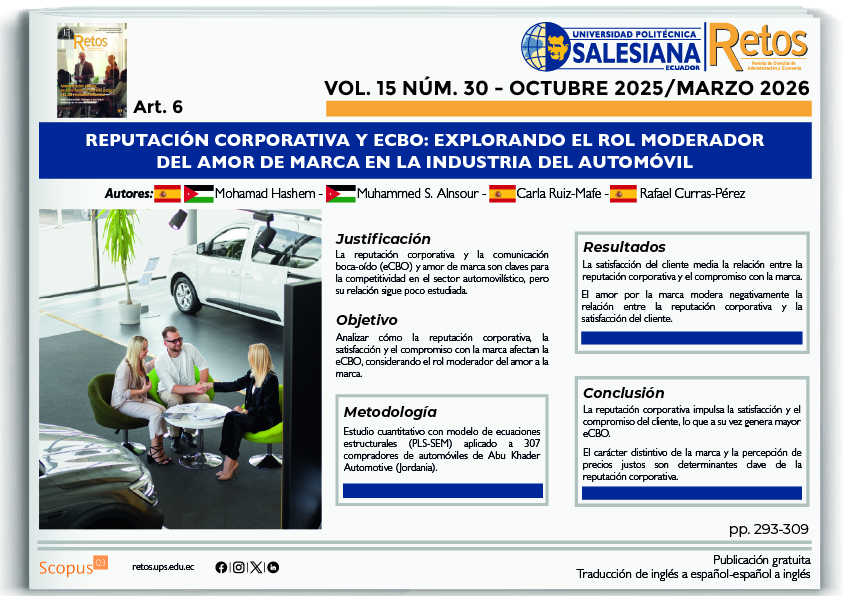
Este estudio analiza las relaciones entre la reputación corporativa, satisfacción del cliente, compromiso con la marca y comunicación boca-oído (eCBO) con especial atención al efecto moderador del amor a la marca. El análisis de datos se realizó mediante modelos de ecuaciones estructurales con mínimos cuadrados parciales (SEM-PLS) con una muestra de 317 compradores de automóviles durante 2020-2022. La reputación corporativa, mediada por la satisfacción, aumenta el compromiso con la marca del cliente, lo que a su vez impulsa el eCBO para las marcas de automóviles. El carácter distintivo de la marca y la justicia percibida en precios son predictores robustos de la reputación corporativa. El impacto de la reputación corporativa en la satisfacción del cliente con el concesionario de automóviles es menor para los clientes que aman la marca del automóvil adquirido. Este trabajo es novedoso al explicar la eCBO a través de la reputación corporativa, la satisfacción y el compromiso de la marca del cliente. También proporciona nuevos conocimientos al revelar: (i) el papel moderador negativo del amor a la marca en la relación entre la reputación corporativa y la satisfacción (ii) el papel mediador de la satisfacción al vincular la reputación corporativa con el compromiso de la marca del cliente; (iii) cómo se puede explicar la reputación corporativa a través de los efectos del carácter distintivo de la marca y la justicia percibida en precios del concesionario.
Detalles del artículo

Esta obra está bajo una licencia internacional Creative Commons Atribución-NoComercial-CompartirIgual 4.0.
Autoría: La lista de autores firmantes debe incluir únicamente a aquellas personas que hayan contribuido intelectualmente al desarrollo del trabajo. La colaboración en la recogida de datos no es, por sí misma, criterio suficiente de autoría. "Retos" declina toda responsabilidad por posibles conflictos derivados de la autoría de los trabajos que se publiquen.
Derechos de autor: La Universidad Politécnica Salesiana preserva los derechos de autor de los artículos publicados, y favorece y permite su reutilización bajo la licencia Creative Commons Attribution-NonCommercial-ShareAlike 3.0 Ecuador. Pueden ser copiados, utilizados, difundidos, transmitidos y expuestos públicamente, siempre y cuando: i) se cite la autoría y la fuente original de su publicación (revista, editorial y URL del trabajo); (Ii) no se utilicen con fines comerciales; Iii) se mencione la existencia y especificaciones de esta licencia.
Referencias
1. Andaleeb, S. S., & Basu, A. K. (1994). Technical complexity and consumer knowledge as moderators of service quality evaluation in the automobile service industry. Journal of Retailing, 70(4), 367–381.
2. Bagozzi, R. P., & Yi, Y. (1988). On the evaluation of structural equation models. Journal of the Academy of Marketing Science, 16(1), 74–94. https://doi.org/10.1007/BF02723327
3. Bagozzi, R. P., Gopinath, M., & Nyer, P. U. (1999). The Role of Emotions in Marketing. Journal of the Academy of Marketing Science, 27(2), 184–206. https://doi.org/10.1177/0092070399272005
4. Baumgartner, K. T., Ernst, C. A., & Fischer, T. M. (2022). How Corporate Reputation Disclosures Affect Stakeholders’ Behavioral Intentions: Mediating Mechanisms of Perceived Organizational Performance and Corporate Reputation. Journal of Business Ethics, 175(2), 361–389. https://doi.org/10.1007/s10551-020-04642-x
5. Brodie, R. J., Ilic, A., Juric, B., & Hollebeek, L. (2013). Consumer engagement in a virtual brand community: An exploratory analysis. Journal of Business Research, 66(1), 105–114.
6. Carroll, B. A., & Ahuvia, A. C. (2006). Some antecedents and outcomes of brand love. Marketing Letters, 17(2), 79–89. https://doi.org/10.1007/s11002-006-4219-2
7. Chen, Y., & Liao, L. (2024). How Does Digital Transformation Affect Corporate Reputation-Evidence From Listed Companies in China. https://www.researchsquare.com/article/rs-5442590/latest
8. Cheung, M. L., Leung, W. K. S., Yang, M. X., Koay, K. Y., & Chang, M. K. (2022). Exploring the nexus of social media influencers and consumer brand engagement. Asia Pacific Journal of Marketing and Logistics, 34(10), 2370–2385. https://doi.org/10.1108/APJML-07-2021-0522
9. Doney, P. M., & Cannon, J. P. (1997). An Examination of the Nature of Trust in Buyer–Seller Relationships. Journal of Marketing, 61(2), 35–51. https://doi.org/10.1177/002224299706100203
10. Dwivedi, A., Nayeem, T., & Murshed, F. (2018). Brand experience and consumers’ willingness-to-pay (WTP) a price premium: Mediating role of brand credibility and perceived uniqueness. Journal of Retailing and Consumer Services, 44, 100–107.
11. Festinger, L. (1957). Social comparison theory. Selective Exposure Theory, 16(401), 3.
12. Fitri, R. A., & Wulandari, R. (2020). Online purchase intention factors in Indonesian millenial. International Review of Management and Marketing, 10(3), 122.
13. Fornell, C., & Larcker, D. F. (1981). Evaluating Structural Equation Models with Unobservable Variables and Measurement Error. Journal of Marketing Research, 18(1), 39–50. https://doi.org/10.1177/002224378101800104
14. Galbreath, J., & Shum, P. (2012). Do customer satisfaction and reputation mediate the CSR–FP link? Evidence from Australia. Australian Journal of Management, 37(2), 211–229. https://doi.org/10.1177/0312896211432941
15. Gumparthi, V. P., & Patra, S. (2020). The Phenomenon of Brand Love: A Systematic Literature Review. Journal of Relationship Marketing, 19(2), 93–132. https://doi.org/10.1080/15332667.2019.1664871
16. Gupta, R., & Raman, S. (2022). After-sale service experiences and customer satisfaction: An empirical study from the Indian automobile industry. Research in Transportation Business & Management, 45, 100873.
17. Hollebeek, L. D., Glynn, M. S., & Brodie, R. J. (2014). Consumer Brand Engagement in Social Media: Conceptualization, Scale Development and Validation. Journal of Interactive Marketing, 28(2), 149–165. https://doi.org/10.1016/j.intmar.2013.12.002
18. Ismagilova, E., Dwivedi, Y. K., Slade, E., & Williams, M. D. (2017). Electronic Word-of-Mouth (eWOM). In E. Ismagilova, Y. K. Dwivedi, E. Slade, & M. D. Williams, Electronic Word of Mouth (eWOM) in the Marketing Context (pp. 17–30). Springer International Publishing. https://doi.org/10.1007/978-3-319-52459-7_3
19. Knoll, J. (2016). Advertising in social media: A review of empirical evidence. International Journal of Advertising, 35(2), 266–300. https://doi.org/10.1080/02650487.2015.1021898
20. Küster-Boluda, I., Ruiz-Mafé, C., & Orozco-Grover, G. (2024). Sports brand love 2.0 in the context of football teams. Managing Sport and Leisure, 1–18. https://doi.org/10.1080/23750472.2023.2299835
21. Lim, W. M., Rasul, T., Kumar, S., & Ala, M. (2022). Past, present, and future of customer engagement. Journal of Business Research, 140, 439–458.
22. Martínez-López, F. J., Anaya-Sánchez, R., Molinillo, S., Aguilar-Illescas, R., & Esteban-Millat, I. (2017). Consumer engagement in an online brand community. Electronic Commerce Research and Applications, 23, 24–37.
23. Montazeri, A. (2024). Corporate social responsibility: The key to improving brand equity and reputation for local sports associations in Islamic countries. Journal of Islamic Marketing. https://www.emerald.com/insight/content/doi/10.1108/JIMA-10-2023-0314/full/html
24. Mukhopadhyay, S., Pandey, R., & Rishi, B. (2023). Electronic word of mouth (eWOM) research–a comparative bibliometric analysis and future research insight. Journal of Hospitality and Tourism Insights, 6(2), 404–424.
25. Oliver, R. L. (1980). A Cognitive Model of the Antecedents and Consequences of Satisfaction Decisions. Journal of Marketing Research, 17(4), 460–469. https://doi.org/10.1177/002224378001700405
26. Osakwe, C. N., & Yusuf, T. O. (2021). CSR: A roadmap towards customer loyalty. Total Quality Management & Business Excellence, 32(13–14), 1424–1440. https://doi.org/10.1080/14783363.2020.1730174
27. Perera, C. H., Nayak, R., & Long, N. V. T. (2019). The Impact of electronic-word-of mouth on e-loyalty and consumers’e-purchase decision making process: A Social media perspective. International Journal of Trade, Economics and Finance, 10(4), 85–91.
28. Poan, R., & Verin, C. Y. (2024). The impact of Islamic tourism on the satisfaction of local tourists. Journal of Islamic Marketing. https:doi/10.1108/JIMA-05-2023-0157/
29. Prentice, C., Weaven, S., & Wong, I. A. (2020). Linking AI quality performance and customer engagement: The moderating effect of AI preference. International Journal of Hospitality Management, 90, 102629.
30. Quintana-García, C., Benavides-Chicón, C. G., & Marchante-Lara, M. (2021). Does a green supply chain improve corporate reputation? Empirical evidence from European manufacturing sectors. Industrial Marketing Management, 92, 344–353.
31. Rahman, R., Langner, T., & Temme, D. (2021). Brand love: Conceptual and empirical investigation of a holistic causal model. Journal of Brand Management, 28(6), 609–642. https://doi.org/10.1057/s41262-021-00237-7
32. Research and Markets. (2023). Jordan Automotive Market: Size, Share, Outlook. Retrieved from https://www.researchandmarkets.com/reports/5713278/jordan-automotive-market-size-share-outlook#
33. Ringle, C. M., Sarstedt, M., Sinkovics, N., & Sinkovics, R. R. (2023). A perspective on using partial least squares structural equation modelling in data articles. Data in Brief, 48, 109074.
34. Sánchez-Iglesias, N., García-Madariaga, J., & Jerez, M. (2024). The impact of financial performance and corporate reputation on customer purchases: The role of stakeholders and brand value in the automotive sector. Marketing Intelligence & Planning, 42(1), 23–39.
35. Shahroudi, K., & Naimi, S. S. (2014). The impact of brand image on customer satisfaction and loyalty intention (case study: Consumer of hygiene products). International Journal of Engineering Innovations and Research, 3(1), 57.
36. Sivadas, E., & Baker-Prewitt, J. L. (2000). An examination of the relationship between service quality, customer satisfaction, and store loyalty. International Journal of Retail & Distribution Management, 28(2), 73–82.
37. Sørensen, F., Fuglsang, L., Sundbo, J., & Jensen, J. F. (2020). Tourism practices and experience value creation: The case of a themed attraction restaurant. Tourist Studies, 20(3), 271–297. https://doi.org/10.1177/1468797619899347
38. Syah, T. Y. R., & Olivia, D. (2022). Enhancing Patronage Intention on Online Fashion Industry in Indonesia: The Role of Value Co-Creation, Brand Image, and E-Service Quality. Cogent Business & Management, 9(1), 2065790. https://doi.org/10.1080/23311975.2022.2065790
39. Weiner, B. (2018). Attribution theory in organizational behavior: A relationship of mutual benefit. In Attribution Theory (pp. 3–6). Routledge.
40. Zarantonello, L., Romani, S., Grappi, S., & Fetscherin, M. (2018). Trajectories of brand hate. Journal of Brand Management, 25(6), 549–560. https://doi.org/10.1057/s41262-018-0105-5