

Clasificación de fracturas en extremidades superiores con aprendizaje profundo
Barra lateral del artículo
Contenido principal del artículo
Resumen
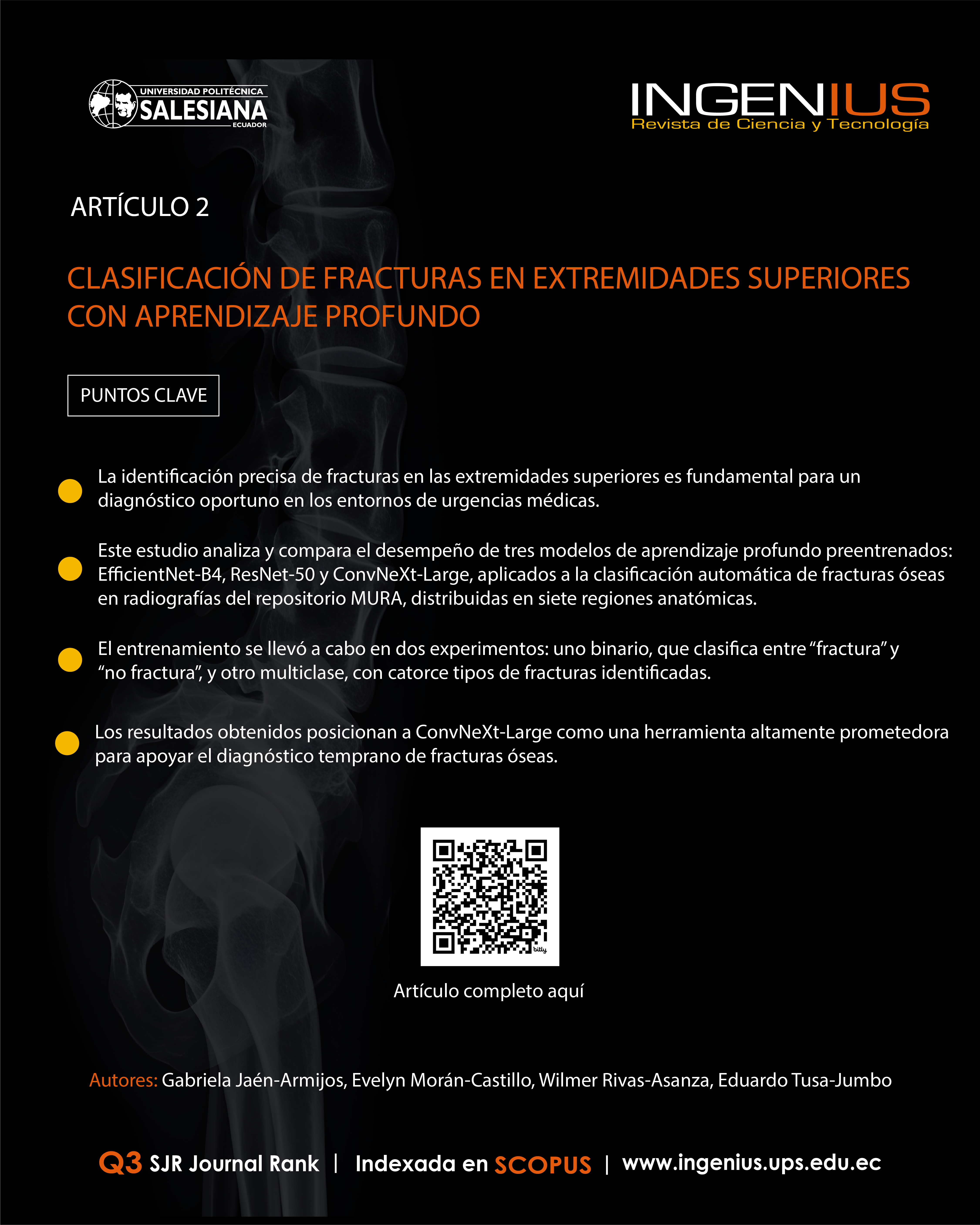
La identificación precisa de fracturas en las extremidades superiores es fundamental para un diagnóstico oportuno en los entornos de urgencias médicas. Este estudio analiza y compara el desempeño de tres modelos de aprendizaje profundo preentrenados: EfficientNet-B4, ResNet-50 y ConvNeXt-Large, aplicados a la clasificación automática de fracturas óseas en radiografías del repositorio MURA, distribuidas en siete regiones anatómicas. Se aplicaron técnicas avanzadas de preprocesamiento digital, como Unsharp Masking y CLAHE, junto con estrategias de normalización y balanceo de datos. El entrenamiento se llevó a cabo en dos experimentos: uno binario, que clasifica entre “fractura” y “no fractura”, y otro multiclase, con catorce tipos de fracturas identificadas. La evaluación, mediante métricas como F1-Score, sensibilidad, exactitud y curvas ROC-AUC, reveló que ConvNeXt-Large alcanzó el mejor rendimiento, logrando una precisión del 99,0 % en clasificación binaria y del 99,4 % en la clasificación multiclase. Estos resultados posicionan a ConvNeXt-Large como una herramienta altamente prometedora para apoyar el diagnóstico temprano de fracturas óseas.
Detalles del artículo

Esta obra está bajo una licencia internacional Creative Commons Atribución-NoComercial-CompartirIgual 4.0.
La Universidad Politécnica Salesiana de Ecuador conserva los derechos patrimoniales (copyright) de las obras publicadas y favorecerá la reutilización de las mismas. Las obras se publican en la edición electrónica de la revista bajo una licencia Creative Commons Reconocimiento / No Comercial-Sin Obra Derivada 4.0 Ecuador: se pueden copiar, usar, difundir, transmitir y exponer públicamente.
El autor/es abajo firmante transfiere parcialmente los derechos de propiedad (copyright) del presente trabajo a la Universidad Politécnica Salesiana del Ecuador, para las ediciones impresas.
Se declara además haber respetado los principios éticos de investigación y estar libre de cualquier conflicto de intereses.
El autor/es certifican que este trabajo no ha sido publicado, ni está en vías de consideración para su publicación en ninguna otra revista u obra editorial.
El autor/es se responsabilizan de su contenido y de haber contribuido a la concepción, diseño y realización del trabajo, análisis e interpretación de datos, y de haber participado en la redacción del texto y sus revisiones, así como en la aprobación de la versión que finalmente se remite en adjunto.
Referencias
[1] J. S. Alvarez Silva, J. E. Chávez Guerrero, D. S. Gutiérrez Carvajal, and L. B. Santos Rivas, “Manejo de emergencias en traumatología,” Polo del conocimiento, vol. 8, no. 4, pp. 2392–2414, 2023. [Online]. Available: https://upsalesiana.ec/ing35ar2r1
[2] E. M. Bitar Benítez, S. Gaviria Posada, N. d. León Fernández, and S. Gallego Gónima, “Epidemiología del trauma de miembro superior atendido en seis instituciones de salud de la ciudad de Medellín, Colombia, en 2016,” Cirugía Plástica Ibero-Latinoamericana, vol. 47, no. 3, pp. 323–332, Sep. 2021. [Online]. Available: https://dx.doi.org/10.4321/s0376-78922021000300014
[3] Y. Xie, X. Li, F. Chen, R. Wen, Y. Jing, C. Liu, and J. Wang, “Artificial intelligence diagnostic model for multi-site fracture X-ray images of extremities based on deep convolutional neural networks,” Quantitative Imaging in Medicine and Surgery, vol. 14, no. 2, pp. 1930–1943, Feb. 2024. [Online]. Available: https://dx.doi.org/10.21037/qims-23-878
[4] A. Said, M. Abbas Al-Adilee, and M. Rajeswari, “Enhancing bone fracture diagnosis with deep learning,” in Conference: 5th International Conference on Data Engineering and Communication Technology (ICDECT)At: Kuala Lumpur, Malaysia, 09 2024. [Online]. Available: https://upsalesiana.ec/ing35ar2r4
[5] Z. Alammar, L. Alzubaidi, J. Zhang, J. Santamaría, Y. Li, and Y. Gu, “A concise review on deep learning for musculoskeletal X-ray images,” in 2022 International Conference on Digital Image Computing: Techniques and Applications (DICTA). IEEE, Nov. 2022, pp. 1–8. [Online]. Available: https://doi.org/10.1109/DICTA56598.2022.10034618
[6] A. Pérez del Barrio, P. Menéndez Fernández-Miranda, P. Sanz Bellón, L. Lloret Iglesias, and D. Rodríguez González, “Inteligencia artificial en radiología: introducción a los conceptos más importantes,” Radiología, vol. 64, no. 3, pp. 228–236, May 2022. [Online]. Available: https://doi.org/10.1016/j.rx.2022.03.003
[7] J. D. Maravilla González, “Integración de la inteligencia artificial en la contabilidad forense: Herramientas y eficacia en la detección de fraudes: Integration of artificial intelligence in forensic accounting: Tools and effectiveness in fraud detection,” LATAM Revista Latinoamericana de Ciencias Sociales y Humanidades, vol. 5, no. 4, Aug. 2024. [Online]. Available: https://doi.org/10.56712/latam.v5i4.2460
[8] S. C. Medaramatla, C. V. Samhitha, S. D. Pande, and S. R. Vinta, “Detection of hand bone fractures in x-ray images using hybrid YOLO NAS+,” IEEE Access, vol. 12, pp. 57 661–57 673, 2024. [Online]. Available: https://doi.org/10.1109/ACCESS.2024.3379760
[9] J. Wang, “Anomaly detection of arm X-ray based on deep learning,” IOP Conference Series: Earth and Environmental Science, vol. 440, no. 4, p. 042056, Feb. 2020. [Online]. Available: https://doi.org/10.1088/1755-1315/440/4/042056
[10] B. Guan, G. Zhang, J. Yao, X. Wang, and M.Wang, “Arm fracture detection in X-rays based on improved deep convolutional neural network,” Computers & Electrical Engineering, vol. 81, p. 106530, Jan. 2020. [Online]. Available: https://doi.org/10.1016/j.compeleceng.2019.106530
[11] A. Pak, A. Ziyaden, K. Tukeshev, A. Jaxylykova, and D. Abdullina, “Comparative analysis of deep learning methods of detection of diabetic retinopathy,” Cogent Engineering, vol. 7, no. 1, Jan. 2020. [Online]. Available: https://doi.org/10.1080/23311916.2020.1805144
[12] M. A. Thaarakaraam, M. M. Reddy, and V. Vijayakumar, “CNN based bone fracture detection for medical imaging using RESNET-50,” International Journal of Technical Research & Science, vol. 9, no. Spl, pp. 27–35, Jun. 2024. [Online]. Available: https://doi.org/10.30780/specialissue-iset-2024/038
[13] Z. Li, T. Gu, B. Li, W. Xu, X. He, and X. Hui, “Convnext-based fine-grained image classification and bilinear attention mechanism model,” Applied Sciences, vol. 12, no. 18, p. 9016, Sep. 2022. [Online]. Available: https://doi.org/10.3390/app12189016
[14] C. A. Mejía Rodríguez, M. A. Rincón Pinzón, L. M. Palmera Quintero, and L. M. Arévalo Vergel, “Aplicación de machine learning y metodología CRISP-DM para la clasificación precisa de severidad en casos de dengue,” Revista Co,ombiana de Tecnologías de Avanzada (RCTA), vol. 1, no. 43, pp. 78–85, Mar. 2024. [Online]. Available: https://doi.org/10.24054/rcta.v1i43.2822
[15] C. Schröer, F. Kruse, and J. M. Gómez, “A systematic literature review on applying CRISPDM process model,” Procedia Computer Science, vol. 181, pp. 526–534, 2021. [Online]. Available: https://doi.org/10.1016/j.procs.2021.01.199
[16] D. Dzulhijjah, M. Herlambang, and M. Haifan, “Implementasi framework CRISP-DM untuk proses data mining aplikasi credit scoring PT. XYZ,” in Seminar Nasional Sains dan Teknologi "SainTek", 06 2024. [Online]. Available: https://upsalesiana.ec/ing35ar2r16
[17] V. García-Ríos, M. Marres-Salhuana, F. Sierra-Liñán, and M. Cabanillas-Carbonell, “Predictive machine learning applying cross industry standard process for data mining for the diagnosis of diabetes mellitus type 2,” IAES International Journal of Artificial Intelligence (IJ-AI), vol. 12, no. 4, p. 1713, Dec. 2023. [Online]. Available: https://doi.org/10.11591/ijai.v12.i4.pp1713-1726
[18] G. Emmanuel, G. G. Hungilo, and A. W. R. Emanuel, “Performance evaluation of machine learning classification techniques for diabetes disease,” IOP Conference Series: Materials Science and Engineering, vol. 1098, no. 5, p. 052082, Mar. 2021. [Online]. Available: https://doi.org/10.1088/1757-899X/1098/5/052082
[19] E. B. Núñez Arias, B. M. González Nuñez, L. N. Fernández, and J. M. Rodríguez Pupo, “CRISP-DM y K-means neutrosofía en el análisis de factores de riesgo de pérdida de audición en niños,” Neutrosophic Computing and Machine Learning, vol. 16, p. 73, 2021. [Online]. Available: https://doi.org/10.5281/zenodo.4679890
[20] ML Group. (2025) Bone X-ray deep learning competition. Stanford ML Group. [Online]. Available: https://upsalesiana.ec/ing35ar2r20
[21] I. Kandel and M. Castelli, “Improving convolutional neural networks performance for image classification using test time augmentation: A case study using MURA dataset,” Health Information Science and Systems, vol. 9, no. 1, Jul. 2021. [Online]. Available: https://doi.org/10.1007/s13755-021-00163-7
[22] K. Dlshad Ahmed and R. Hawezi, “Detection of bone fracture based on machine learning techniques,” Measurement: Sensors, vol. 27, p. 100723, Jun. 2023. [Online]. Available: https://doi.org/10.1016/j.measen.2023.100723
[23] P. Rajpurkar, J. Irvin, A. Bagul, D. Ding, T. Duan, H. Mehta, B. Yang, K. Zhu, D. Laird, R. L. Ball, C. Langlotz, K. Shpanskaya, M. P. Lungren, and A. Y. Ng, “MURA: Large dataset for abnormality detection in musculoskeletal radiographs,” in Proceedings of the 1st Conference on Medical Imaging with Deep Learning (MIDL). arXiv, 2017. [Online]. Available: https://doi.org/10.48550/arXiv.1712.06957
[24] R. Archana and P. S. E. Jeevaraj, “Deep learning models for digital image processing: a review,” Artificial Intelligence Review, vol. 57, no. 1, Jan. 2024. [Online]. Available: https://doi.org/10.1007/s10462-023-10631-z
[25] P. Pandey, R. Gupta, and N. Goel, “Comprehensive review of single image defogging techniques: enhancement, prior, and learning based approaches,” Artificial Intelligence Review, vol. 58, no. 4, Jan. 2025. [Online]. Available: https://doi.org/10.1007/s10462-024-11034-4
[26] A. C. Pavan, S. Lakshmi, and M. Somashekara, “An improved method for reconstruction and enhancing dark images based on CLAHE,” International Research Journal on Advanced Science Hub, vol. 5, no. 02, pp. 40–46, Feb. 2023. [Online]. Available: https://doi.org/10.47392/irjash.2023.011
[27] X. Liu, Comparison of four convolutional neural network-based algorithms for sports Image classification. Atlantis Press International BV, 2024, pp. 178–186. [Online]. Available: https://doi.org/10.2991/978-94-6463-370-2_20
[28] E. Riba, D. Mishkin, D. Ponsa, E. Rublee, and G. Bradski, “Kornia: An open source differentiable computer vision library for Py-Torch,” in Proceedings of the IEEE/CVF Winter Conference on Applications of Computer Vision (WACV). arXiv, 2019. [Online]. Available: https://doi.org/10.48550/arXiv.1910.02190
[29] R. Connor, A. Dearle, B. Claydon, and L. Vadicamo, “Correlations of cross-entropy loss in machine learning,” Entropy, vol. 26, no. 6, p. 491, Jun. 2024. [Online]. Available: https://doi.org/10.3390/e26060491
[30] M. Dörrich, M. Fan, and A. M. Kist, “Impact of mixed precision techniques on training and inference efficiency of deep neural networks,” IEEE Access, vol. 11, pp. 57 627–57 634, 2023. [Online]. Available: https://doi.org/10.1109/ACCESS.2023.3284388
[31] A. Thakur, H. Chauhan, and N. Gupta, “Efficient ResNets: Residual network design,” in NYU Tandon School of Engineering, Tech. Rep. arXiv, 2023. [Online]. Available: https://doi.org/10.48550/arXiv.2306.12100
[32] G. Fang, Y. Dai, Z. Lin, C. Zhou, J. Song, Y. Gu, X. Guo, A. Mao, and X. Kong, “An efficient unsupervised classification model for galaxy morphology: Voting clustering based on coding from convnext large model,” Astronomy & Astrophysics, vol. 693, p. A141, Jan. 2025. [Online]. Available: https://doi.org/10.1051/0004-6361/202451734
[33] A. Anaya-Isaza, L. Mera-Jiménez, and M. Zequera-Díaz, “An overview of deep learning in medical imaging,” Informatics in Medicine Unlocked, vol. 6, p. 100723, 2021. [Online]. Available: https://doi.org/10.1016/j.imu.2021.100723
[34] A. A. Mustapha and M. S. Yoosuf, “Exploring the efficacy and comparative analysis of one-stage object detectors for computer vision: A review,” Multimedia Tools and Applications, vol. 83, no. 20, pp. 59 143–59 168, Dec. 2023. [Online]. Available: https://doi.org/10.1007/s11042-023-17751-2
[35] Y. Nakamura, Y. Ishii, Y. Maruyama, and T. Yamashita, “Few-shot adaptive object detection with cross-domain cutmix,” in Proceedings of the European Conference on Computer Vision (ECCV). arXiv, 2022. [Online]. Available: https://doi.org/10.48550/arXiv.2208.14586
[36] M. T. Mora Cabral, R. G. Camero Berrones, and M. D. Arriaga Pons, “Modelo de identificación espacial de patrones de referencia empleando redes neuronales convolucionales (CNN) y entrenamiento por lotes,” Revista de investigación multidisiplinaria, Iberoamericana, no. 4, Dec. 2024. [Online]. Available: https://doi.org/10.69850/rimi.vi4.125
[37] A. Verma, T. Meenpal, and B. Acharya, “Computational cost reduction of convolution neural networks by insignificant filter removal,” Journal of Information Science and Technology, vol. 25, no. 2, pp. 150–165, 2022. [Online]. Available: https://upsalesiana.ec/ing35ar2r37
[38] C. Guo, R. Zhang, J. Xu, J. Leng, Z. Liu, Z. Huang, M. Guo, H. Wu, S. Zhao, J. Zhao, and K. Zhang, “GMLake: Efficient and Transparent GPU Memory Defragmentation for Large-scale DNN Training with Virtual Memory Stitching,” in arXiv preprint. arXiv, 2024. [Online]. Available: https://doi.org/10.48550/arXiv.2401.08156
[39] V. D. Gil-Vera and C. Seguro-Gallego, “Machine learning aplicado al análisis del rendimiento de desarrollos de software,” Revista Politécnica, vol. 18, no. 35, pp. 128–139, Apr. 2022. [Online]. Available: https://doi.org/10.33571/rpolitec.v18n35a9
[40] F. D. Valle-Medina, L. J. Castillo-Heredia, M. A. Correa-Peralta, and J. E. Guzmán-Seraquive, “Clasificación de enfermedades en hojas de papa utilizando transformadores de visión,” Novasinergia Revista digital de Ciencia, Ingeniería y Tecnología, vol. 8, no. 1, pp. 142–156, Jan. 2025. [Online]. Available: https://doi.org/10.37135/ns.01.15.06
[41] M. Ihme, W. T. Chung, and A. A. Mishra, “Combustion machine learning: Principles, progress and prospects,” Progress in Energy and Combustion cience, vol. 91, p. 101010, Jul. 2022. [Online]. Available: https://doi.org/10.1016/j.pecs.2022.101010
[42] D. Patiño-Pérez, L. Armijos-Valarezo, L. Chóez-Acosta, and F. Burgos-Robalino, “Convolutional neural networks for diabetic retinopathy detection,” Ingenius, no. 33, pp. 91–101, Mar. 2025. [Online]. Available: https://doi.org/10.17163/ings.n33.2025.08
[43] G. Bauce and M. Moya-Sifontes, “Análisis de la curva ROC en la evaluación de indicadores antropométricos,” Revista Digital de Postgrado, vol. 11, no. 1, Aug. 2021. [Online]. Available: https://doi.org/10.37910/RDP.2022.11.1.e333
[44] G. B. Jaén Armijos, “Clasificador de fracturas en extremidades superiores con aprendizaje profundo,” Github, oct 2025, gitHub repository. [Online]. Available: https://upsalesiana.ec/ing35ar2r44